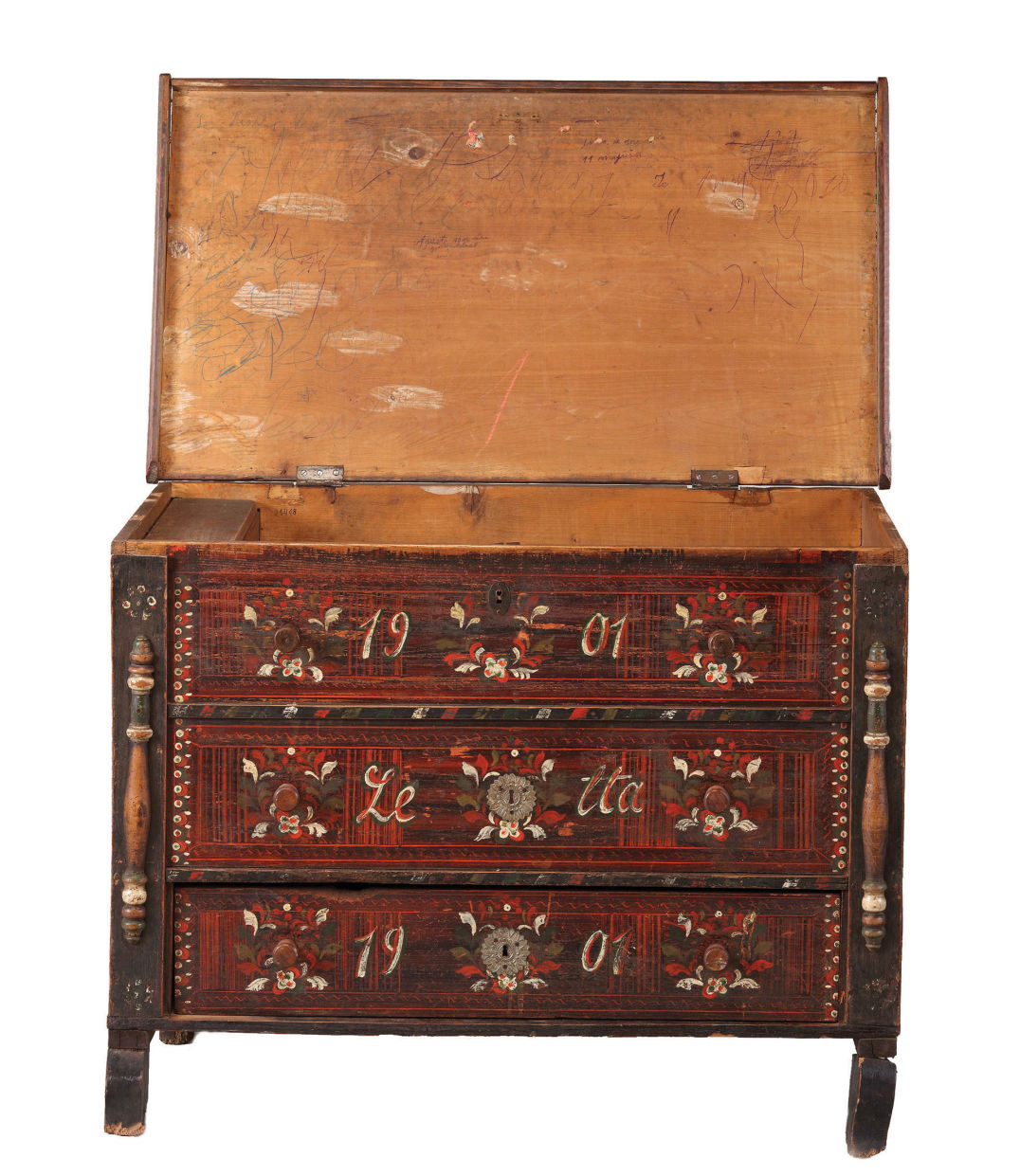
Dresser, 1901, EMZ 21918
The impact of styles of high or elite art on some manifestations of folk art was discovered later by certain ethnologists; by Vitomir Belaj, for example, in the article “Some Renaissance revival elements in rural attire in the surroundings of Bednja” (Belaj 1962/63), and by Đurđica Petrović and Mirjana Prošić - Dvornić (1983) who discovered the influences of Gothic, Renaissance, Baroque, Rococo and Biedermeier in the productions of folk art on individual motifs in textiles and wood Arnold Hauser notes that the changes of styles in high art are much faster and more stepped than the changes of stylistic directions of folk and popular art. He claims that this art only to an insignificant extent takes its cue from the changes that occur in high art. What is today called folk or vernacular art, writes Hauser, was created only in the 18th century. This was the age in which most of the types of furniture and household items that are connected with the term folk art were formed (Hauser 1977: 234).
Peter Burke thinks that in Central Europe in the eighteenth century
there was a rural or peasant Baroque, which was probably about a
whole century later than the original Baroque period. The peasant art of
the time in Norway and Sweden borrowed motifs from the Renaissance,
Baroque and Rococo periods (Burke 1991: 59). Kus-Nikolajev differentiates
peasantised Baroque from rural Baroque, which are considered in
the framework of different studies, Croatian Peasant Baroque (1929) and
Forms of Rural Culture (1934).
In a study about chests from the holdings
of the Ethnographic Museum in Split, Branka Vojnić Traživuk is of the
opinion that the Dalmatian chest can be considered an occurrence of
rustic Baroque, which appeared much later than the original style, open
to the reworking and new impulses of neo-Baroque trends (Vojnović
Traživuk 2010: 34).In a way it followed the painted decoration of furniture in central Europe
during the 19th century that on the one hand aspired to the realism of
its floral motifs and on the other hand the stylisation of floral garlands
(Večerkova 1980: 31).
In the furniture collection of the Ethnographic
Museum in Zagreb there are chests with diverse painted flowers, from
those with one row of petals to complexly blooming roses, from buds to
flowers like tulips. They are incorporated into compositions with scrolling
branches with long green leaves. This motif is thought to derive
from the Renaissance, but in the 19th century was typical of furniture all
over Europe. Chests with lids painted inside and fronts carved with almost
the same motifs were characteristic of the Adriatic area, particularly
Dalmatia. In Slavonia the appearance of Baroque art was influenced
by the political and demographic changes of the end of the 17th and the
early 18th century, by, that is, the colonization of the area by Germans,
Hungarians, Slovaks and Czechs, as well as by part of the population
from the regions still under Turkish occupation, which brought their
artisan trades with them.
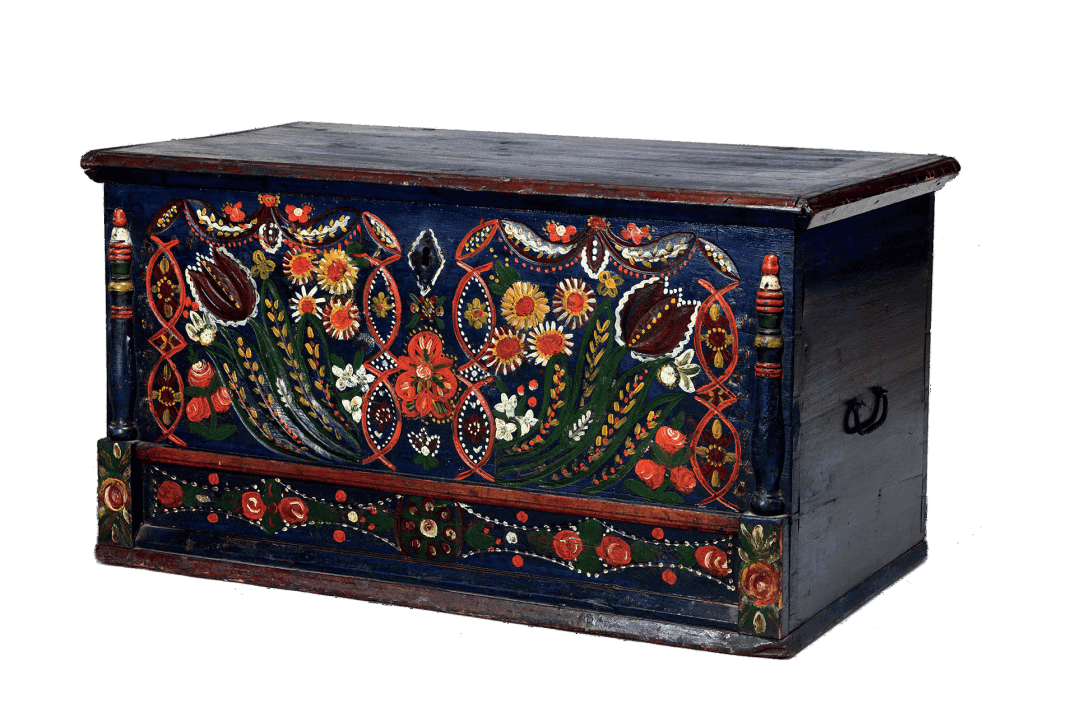
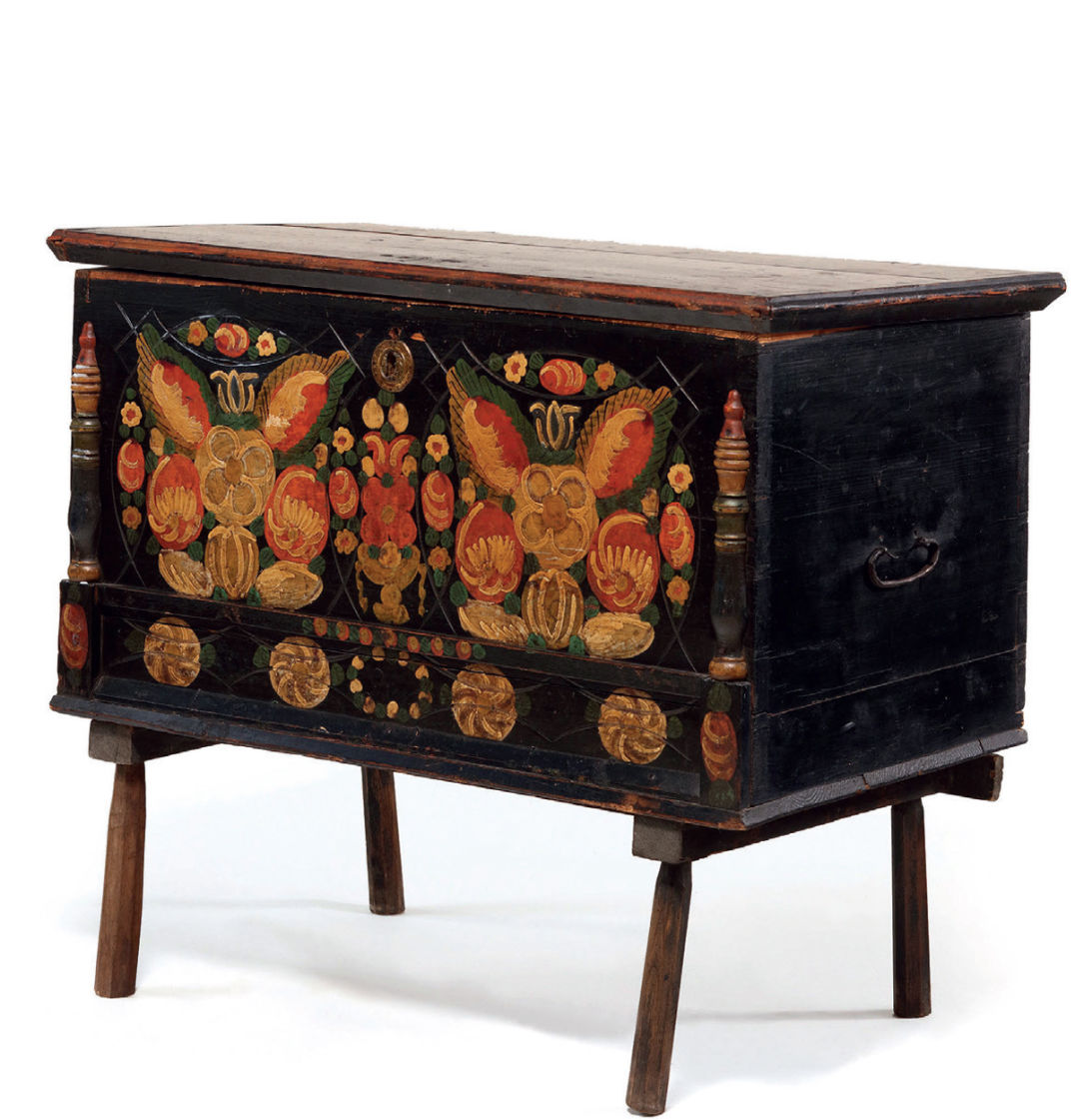
Chest, 19th ct., EMZ 19942
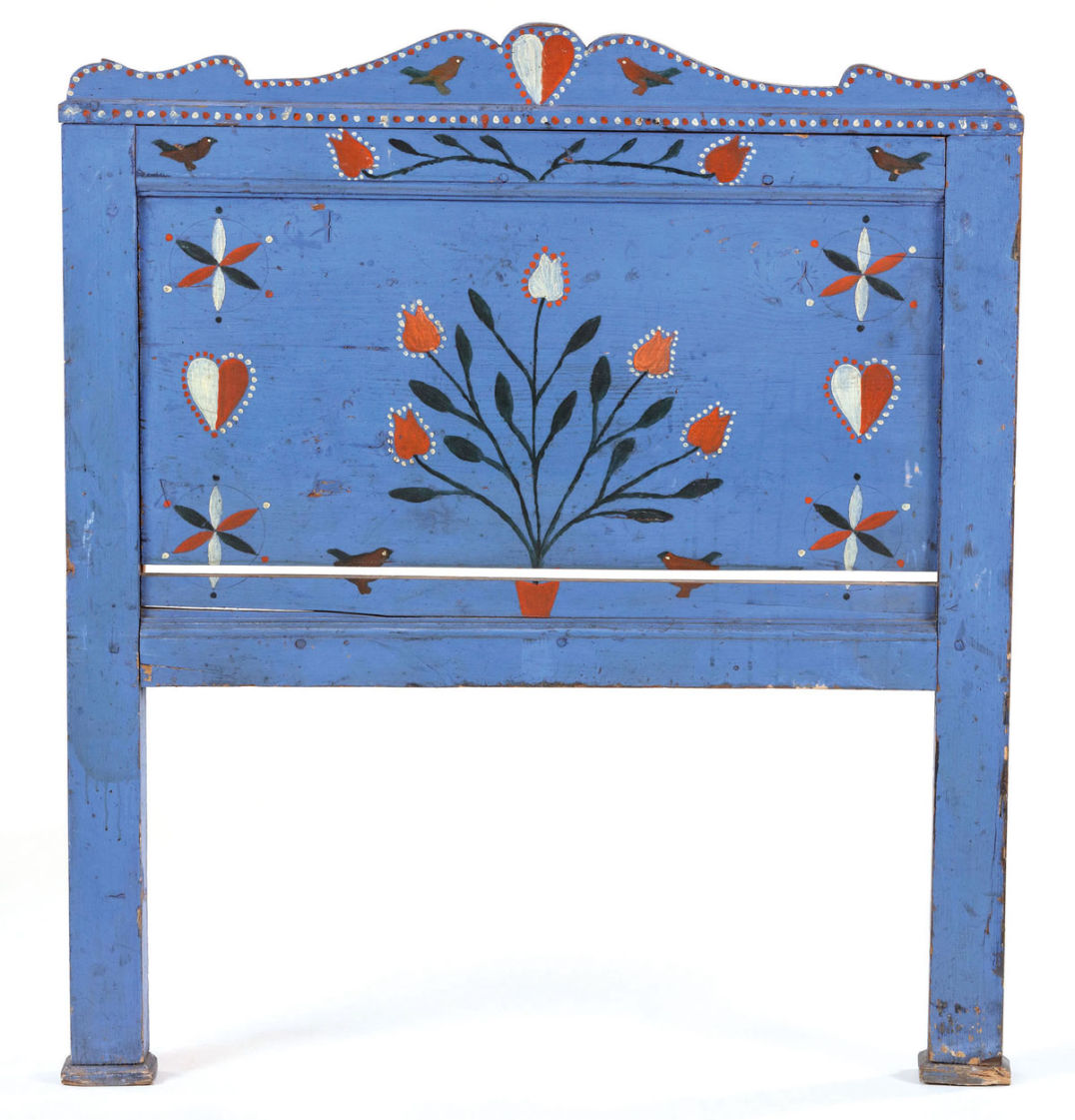
Bed, 19th ct., Baranja, EMZ 20178
Folk art thus branches into art made in village households and art made for the village household. And so painted furniture of Baroquized forms became part of the inventory of peasant households (Senjković 1994: 128). There are several recognisable elements of Baroque style: floral motifs, the use of gold, the heart motif. Thus we were able to identify the Baroque on tables and chairs from the museum collection, as well as on chests and the heads and sides of beds. The floral bouquet motif was often painted on vernacular furniture in Međimurje and Baranya during the 18th century, and the many variants of it can be seen on chests in the museum holdings. The lids and front sides of chests were decorated with geometrical motifs (straight, vertical, slanting and zigzag lines, circles and rosettes). Some chests were ornamented by being painted, and the paint would be used to bring out the basic lines of the ornaments. In Slavonia and Baranya there are chests decorated with circles and rosettes in two colours.
Chest, 19th ct., Baranja, EMZ 19942a
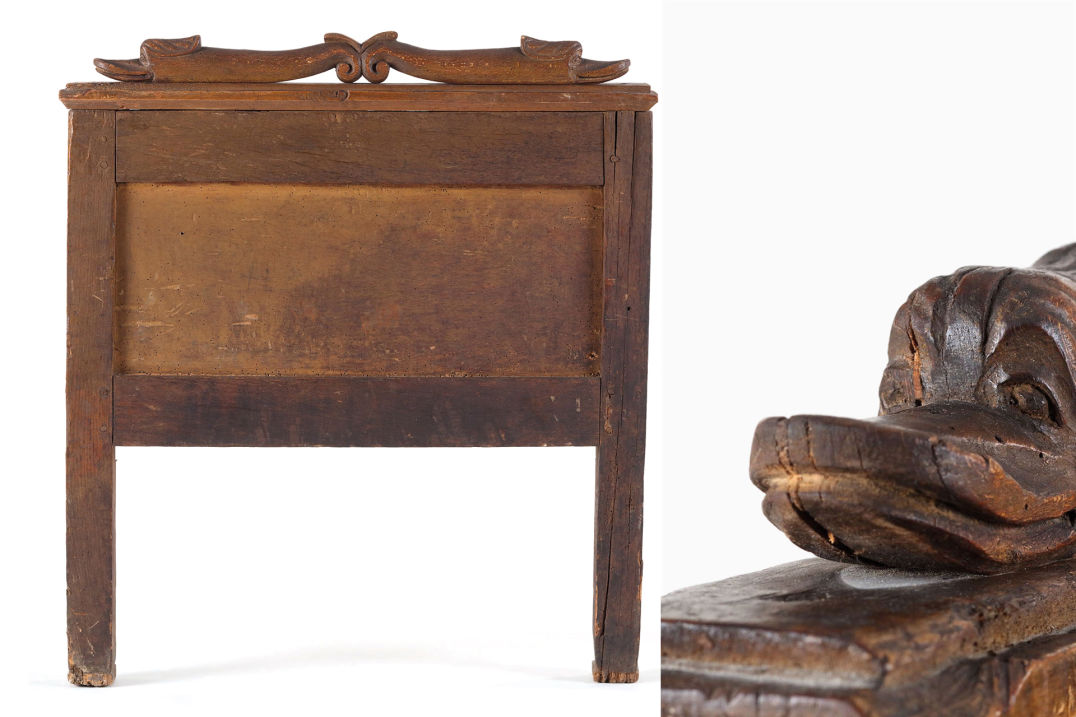
Bed, 20th ct., EMZ 2860
This kind of chest can be found in Istria, where lid and front of a chest are divided into two notional halves, on which there are diagonal lines that create a large check pattern in the centre. The temporal framework in which these objects appeared is approximately the fin-de-siècle. Richer households brought Altdeutch and Biedermeier cabinets and wardrobes into their interiors.