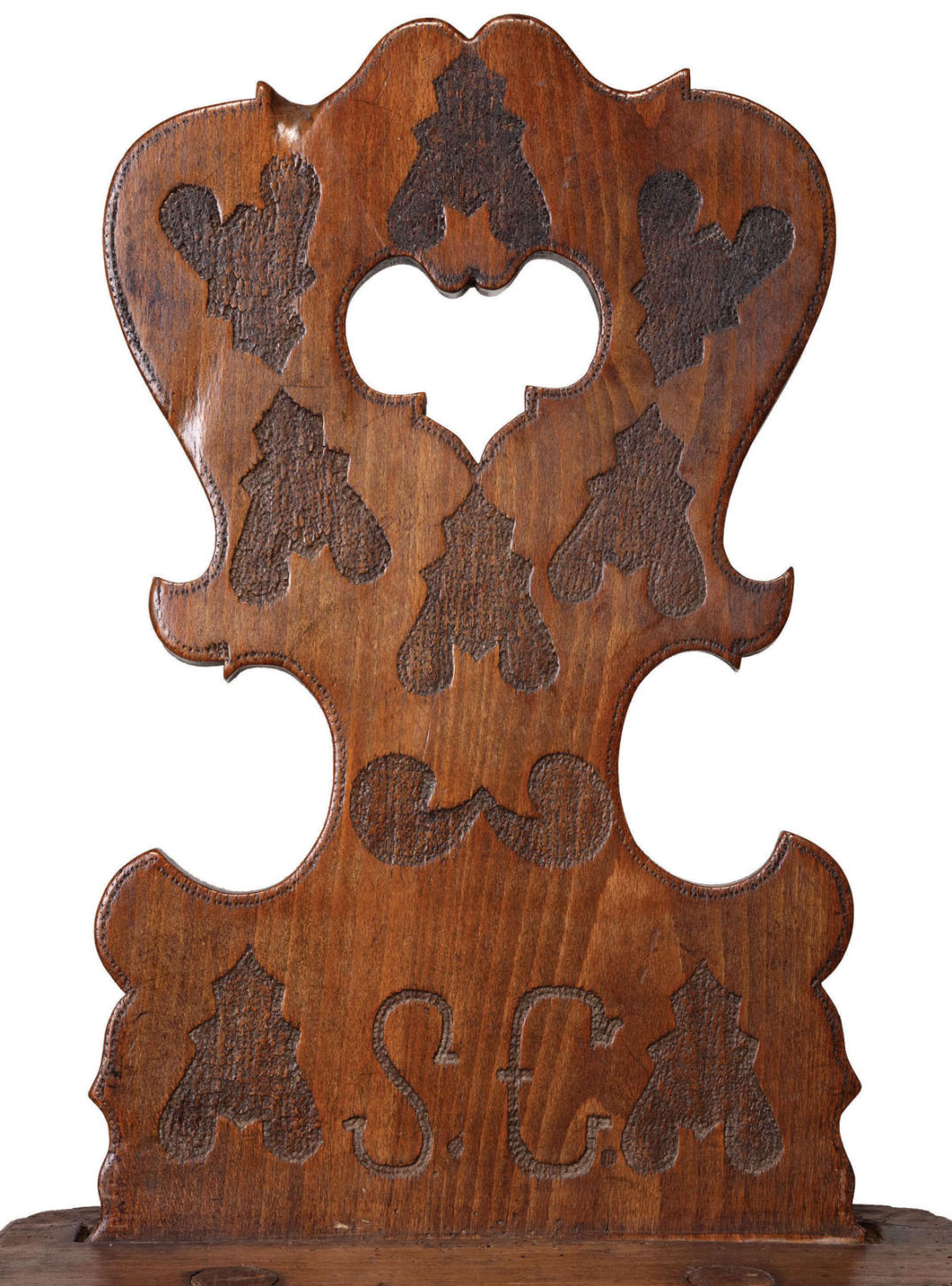
Chair / 19th ct., EMZ 20312
Aleksandra Muraj (Muraj 1998: 83), speaking of the handicraft skills of
the Croatian peasantry at the end of the 19th and in the early 20th century,
pointed out the differences in the manner of producing objects and
their purposes in the light of the way in which the producers obtained
their technological knowledge, the tools they possessed and the distribution
of the products. While the fine craft in the city predicated a
learned skill, an individual commercial and creative purpose, the peasant
craft primarily aimed at the satisfaction of private requirements.
Almost all men could make the simplest kinds of furniture for sitting
on, while the making of for example, chests or chairs with backs,
required greater skill. Levi-Strauss in Science of the concrete (Lévi-
Strauss 1962: 11) differentiates the self-taught producer, who knows
how to make everything with his or her own hands, calling this person
a bricoleur, from the village producer who has learned his trade;
Lévi-Strauss thinks that in a rural community a bricoleur cannot
subsist by himself, but depends on the help of other members of the
community and the transfer of knowledge to the new generations
(Lévi-Strauss 1962: 13). They did not consider pieces of furniture “consumables”
but kept them and handed them down, giving them particular
importance and value. The long-lasting making, from finding
the right wood in its natural condition to its shaping and decoration,
was imbued with the particular knowledge and skill of the individual.
Lévi-Strauss opines that the individual bricoleur puts a creative poetry
into every one of his works, based on the fact that through the medium
of the object, he invests his personality, through the creative selection
and the life environment with its limited capacities, concluding that the
bricoleur leaves a personal trace of himself on every object (Lévi-Strauss
1962: 14)
The museum collection holds objects that were made by talented individuals, rural craftsmen, from natural forms of wood simply selected in nature and adapted to the needs of life. A three-legged stool, with legs made from three branches, dating from 1742, for example, belongs in the group of simply shaped and designed objects. Furniture was made from various types of wood; according to data from the museum inventory cards they mostly used oak, beech, ash, cherry, hornbeam and willow; in the shaping of objects they would very commonly combine different kinds of wood. Apart from this kind of primary shaping, the peasants in the making of objects would apply various techniques, like hewing, sawing, bending and turning. For example, placing a door on half a hollowed-out oak trunk made one of the oldest existing wardrobes from the central area of Croatia. If we analyse the backs of chairs from the museum collection, we can see some imagination in heir making, and almost every one of them is differently decorated, with, for example, heart-shaped cut-outs, and forms of the letter T and V which also served as handles for carrying them. The initials of the owners were carved on such backs. It was on objects of peasant design and making that vernacular aesthetic has been observed. For the expression of their decorative affinities they used various techniques, such as incision with knife or some other metal object (line cutting), gouging (deep cutting), decoration by cutting out (perforation), pokerwork, the insertion of other materials into the wooden base, such as wax or pieces of mirror.
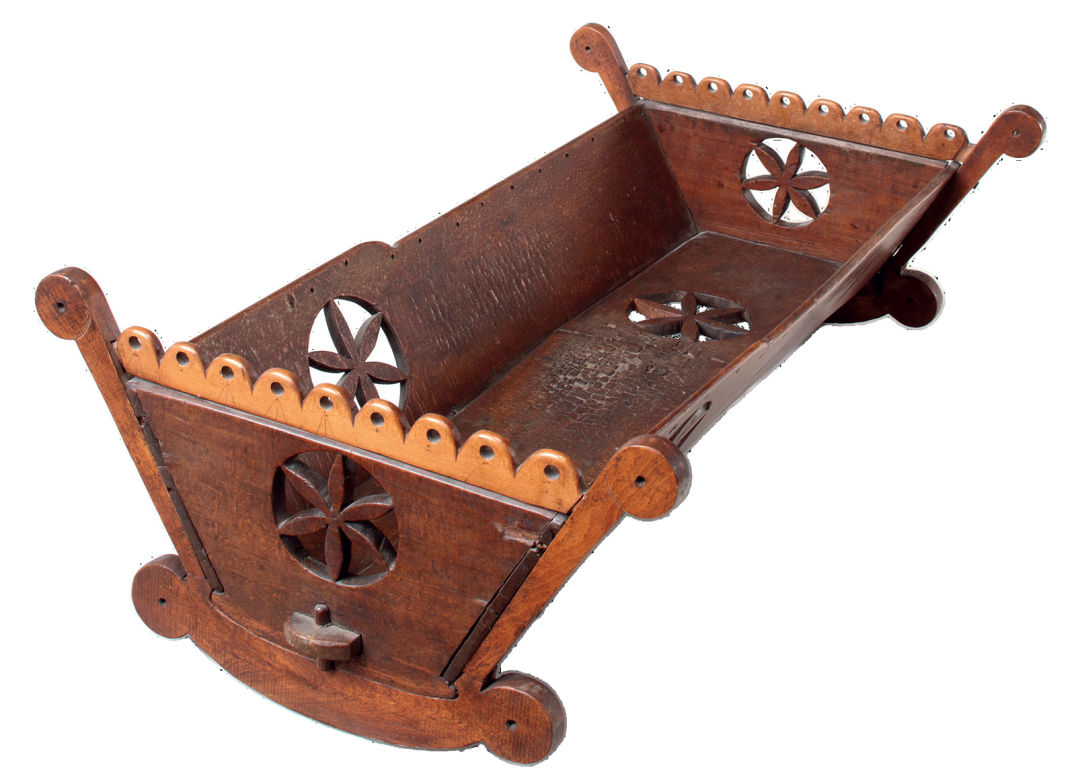
Cradle / 19th ct., EMZ 30268
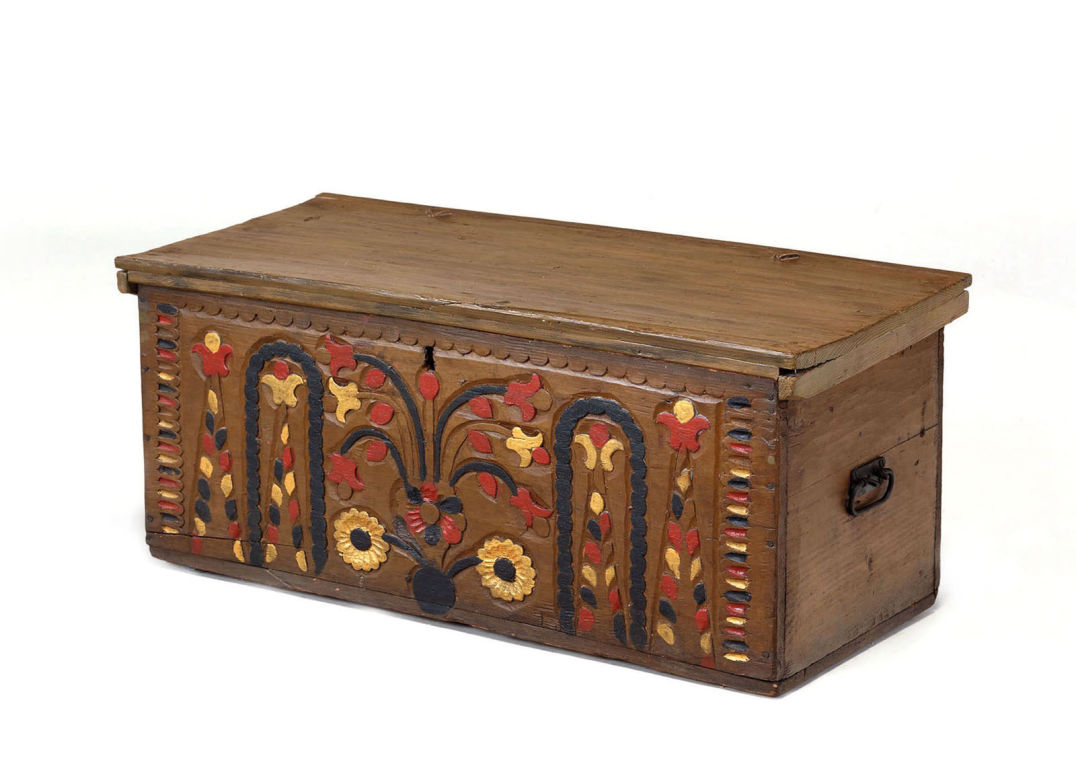
Chest / 19th ct., EMZ 29721
On some museum specimens of chairs, the katrigas with a semicircular seat and three legs that have a back decorated with carving and perforation, as well as free standing sculpture, we can see several ways of composing the decoration. Above all there are the incised, carved or hollowed out motifs characteristic of traditional handicrafts. For example, in some items of furniture, like a cradle, we can find the carved motif of the rosette in a circle, actually a typical decoration of wooden distaffs and textile items in Dalmatia. Carved motifs depended on the kind of wood and on the quantity of carved detail. They also used painting for decoration, as shown by Dalmatian chests and Baranya furniture in the museum holdings. But according to Lévi-Strauss, the bricoleur creates a material object that is also an object of knowledge (Lévi-Strauss 1962: 15). According to the places where the objects were found and collected for the museum collection, and to the museum documentation in which the examples of individual objects are set down, we can assume that they were the products of local craftsmen and that they were created on the model of an existing piece, with the additions of ornaments according to the desires of the person who commissioned them. Marked similarity could suggest the existence of stereotypes, and the difference in the details could come in the final painting, carving, plotting and sawing of the patterns.
This model in the course of time would have become so domesticated as
to become characteristic of a given milieu. Some objects were probably
sold at fairs, like chests, which itinerant painters could have decorated.
Some examples in the museum collection come from Bosnia with carved,
stylised and painted floral motifs on the front of the chests. As well
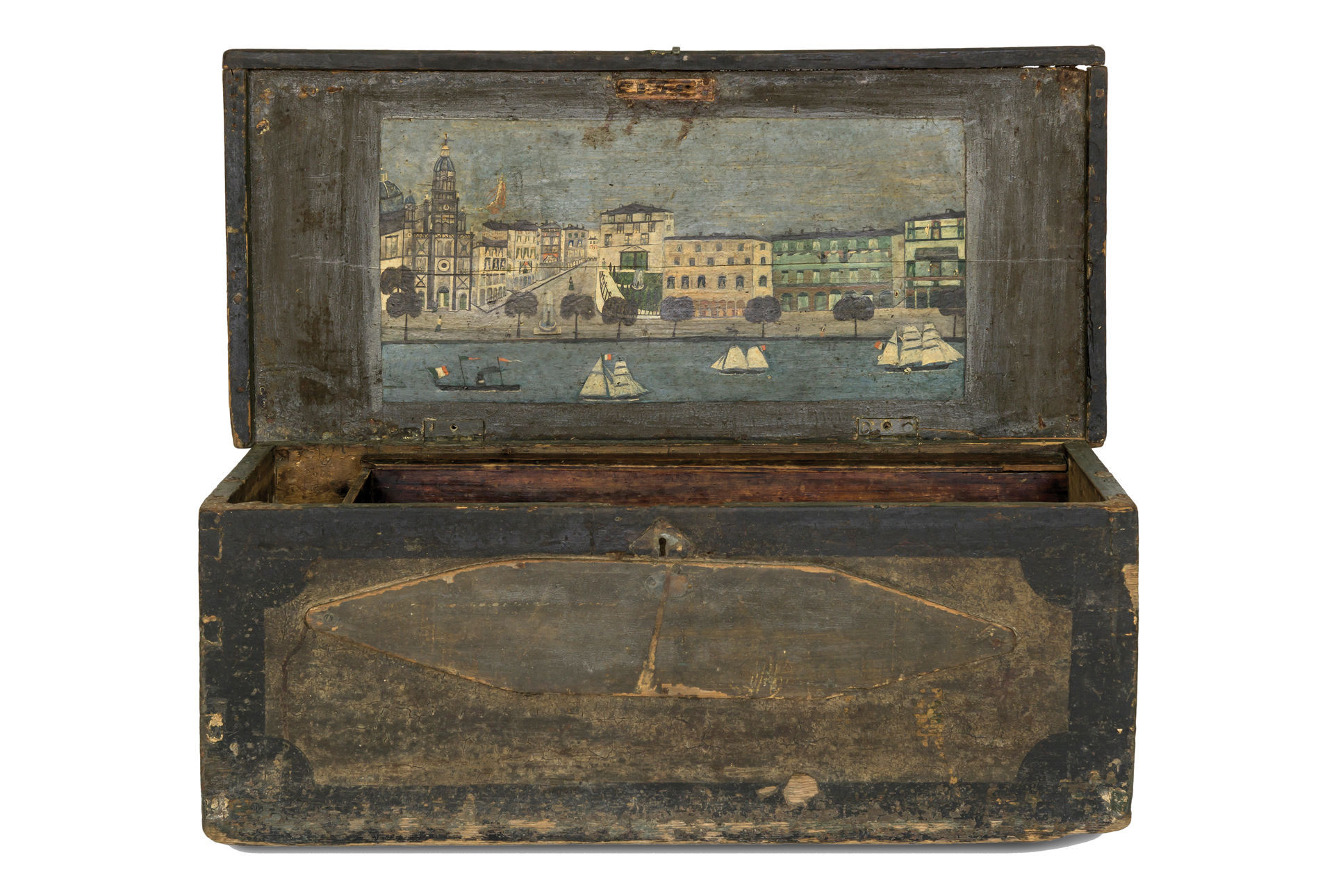
as examples of chests that were completely painted, one should mention
a sea chest that has the front painted with the panorama of a city and a
series of ships sailing before a city and flying the French flag. Another
sea chest in the collection is painted with motifs of cypresses and the
crown of the Italian navy. Such examples of painted chests were very
rare. Probably they were bought during a voyage and brought back to
Croatia. Chests with a figural depiction were restricted to a richer class,
probably to ship’s captains or officers, while those of simpler workmanship,
without decoration, were meant for the ordinary seamen. Chests
of hewn planks were made by rural craftsmen known as škrinjari – chest
makers - on the whole on commission for relatives or people they knew. Some data indicate that the rural craftsmen who made certin specific items of furniture often supplied the whole of their surroundings. For example, in the village of Kuče in Turopolje, chests were produced that
were known far and wide and in the surrounding villages were known as
kuče chests (Antoš, 1998). In Hrvatsko zagorje there were several houses
in the village of Kraševac that went in for making chests. And the making
of chests in this area was well developed, as shown by the fact that
peasants from the environs of Zagreb went to Ivanec Fair to buy them.
Such objects also demonstrated the economic status of people, as was to
be seen in the dimensions of the object, the amount of decorations, the
kind of material. As object, the chest had a particular importance in people’s
private and social lives, as material testimony coming into being in
a given time and cultural setting. Nicely formed and decorated objects
were a source of aesthetic pleasure for the whole community as well as
their owners. It is no surprise, then, that objects were made with a lot
of knowledge, the craftsmen looking for inspiration in the art available
to them, finding new solutions and adapting them, inspired by the new
styles of high art.
Chest / 19th ct., EMZ 15176