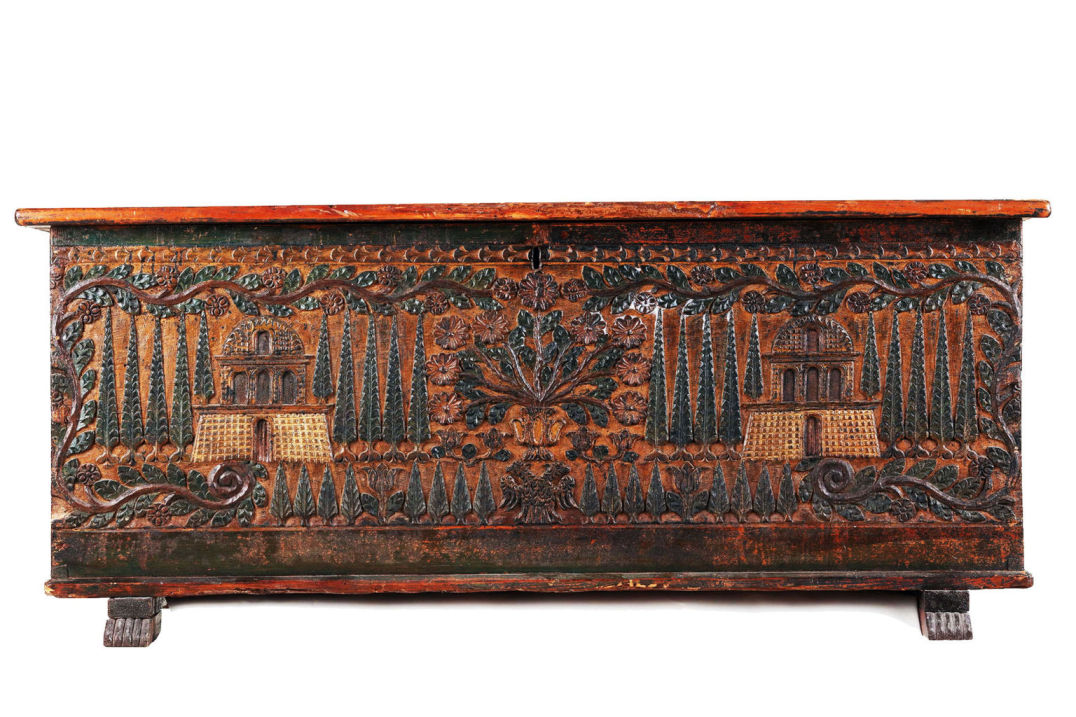
According to analysis of the symbolic themes of carved motifs that
appear on the front of an Adriatic area chest (Vojnović Traživuk 2010:
30) we can find out about the different meanings of the individual motifs
and possible influences. For example a house or temple can be understood
as an image of the universe, as city or temple of the centre of the
world. It is also a female symbol of refuge, maternal protection and the
mother’s breast. Another motif is that of the cypress
tree, which in many
nations is considered a holy tree and because of its long life and lasting
greenery is called the tree of life. A pot or vase of flowers is often also interpreted
as the tree of life. On the particularly lavishly illustrated inside
of the lid of a Dalmatian chest the figure of a bird appears, believed in
the lore of European nations to be an image of the soul of the departed.Some of these symbols have the meaning of the source and tree of life, while cypresses were symbols of death and the immortality of the soul, suggesting the idea that their wider meaning is the passage from life to
death. This interpretation is bolstered by the motif of architecture that
is directly correlated with the meaning of the house of paradise. On the
inside of the lid of a Dalmatian chest from the museum collection, the
centre is emphasised, with a cavity in which to fit a mirror. It is related
to the ideal of female beauty, and thus also oriented to the intimate life
of a woman. The frame consists of the larger square of the sides with
widenings on which a shell is placed, and along the upper side a bird.
The shell motif is a typical female symbol that has erotic connotations,
also indirectly suggesting fruit (pearl). Motifs on chests symbolise the
role of the future mother who by giving birth to numerous progeny will
actively take part in the cyclical renewal of life. Some objects in the collection
of furniture have the Christ monogram (IHS) carved on them; Kus-
Nikolajev ascribes to this an apotropaic role, calling it the Jesus stamp
(Kus-Nikolajev 1928: 50). They also ascribed an apotropaic function to
some geometrical figures and symbols such as the circle, pentagram and
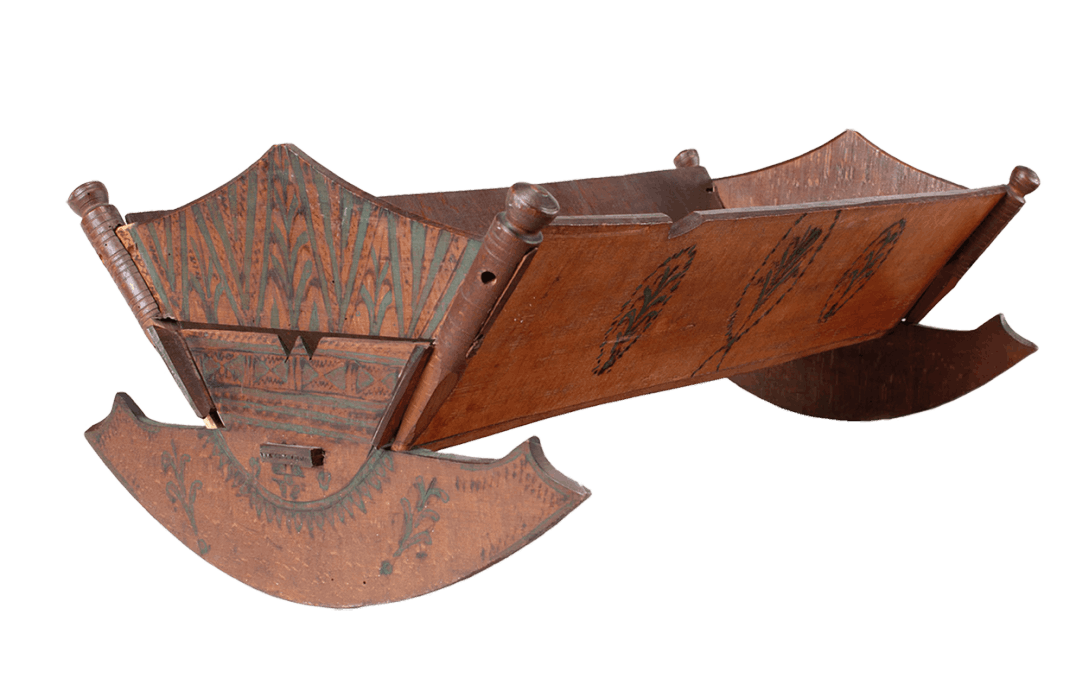
hexagram that were drawn on or incised into cradles, chairs and chests.