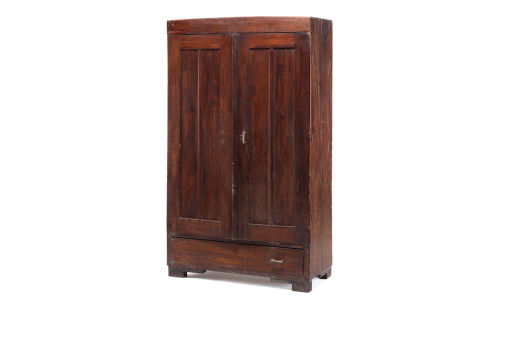
WARDROBES
Gradually in the first half of the 20th century the old crates and chests in which textile items would often be untidily crammed in together with family documents and valuables gradually vanished from kitchens and bedroom. It is not possible to determine the precise turning points of the use of furniture in any given house, and chests would often be used in parallel with the appearance of new forms of furniture. An important role was taken by the increase of the number of wardrobes, cabinets, chests of drawers and glass-fronted cabinets which enabled things to be classified into certain categories, separating one from another according to their function and use. Some owners if they could write would write in the insides of the doors of their wardrobes the names and birthdays of their children, and the wardrobe, like the whole of the bedroom furniture became a part of their private and intimate life. Like chests and other furnishing for the bedroom, wardrobes were part of the dowry or
portion and were transported to the house of the groom.
The older type of wardrobe for clothing had a one-leaf door. Clothes were not layered as in a chest, but hung. Other textiles (bedding, towels and so on) were mostly folded in three shelves in a row. Wardrobes often have a wrought decoration located in the upper part of a single-leaf door. The door is closed with a lock that shuts the top and bottom part of the door at the same time. Some wardrobes were painted or decorated with inlay. A particularly interesting wardrobe in the museum collection decorated
with geometrical motifs comes from Razvor, Hrvatsko zagorje.