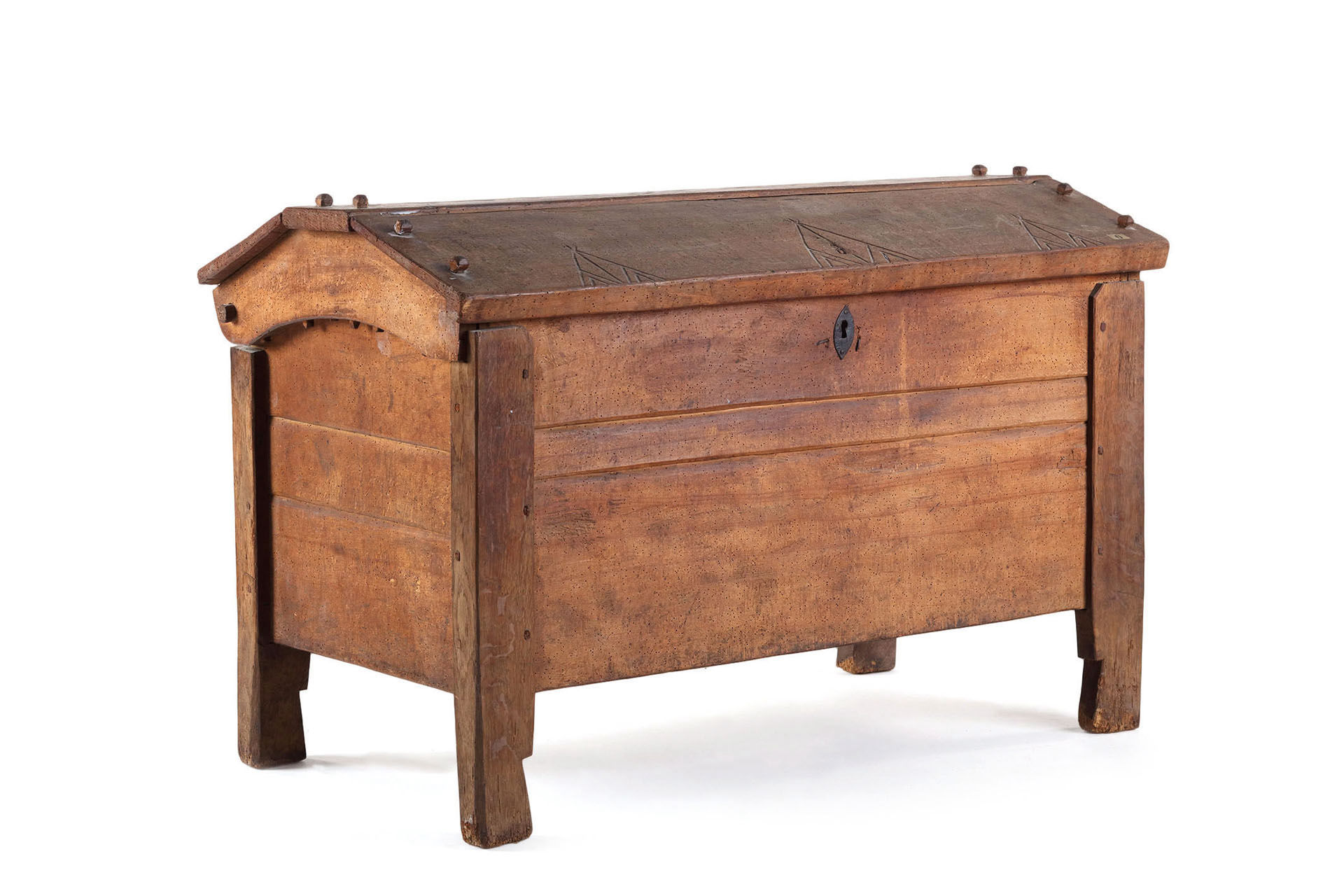
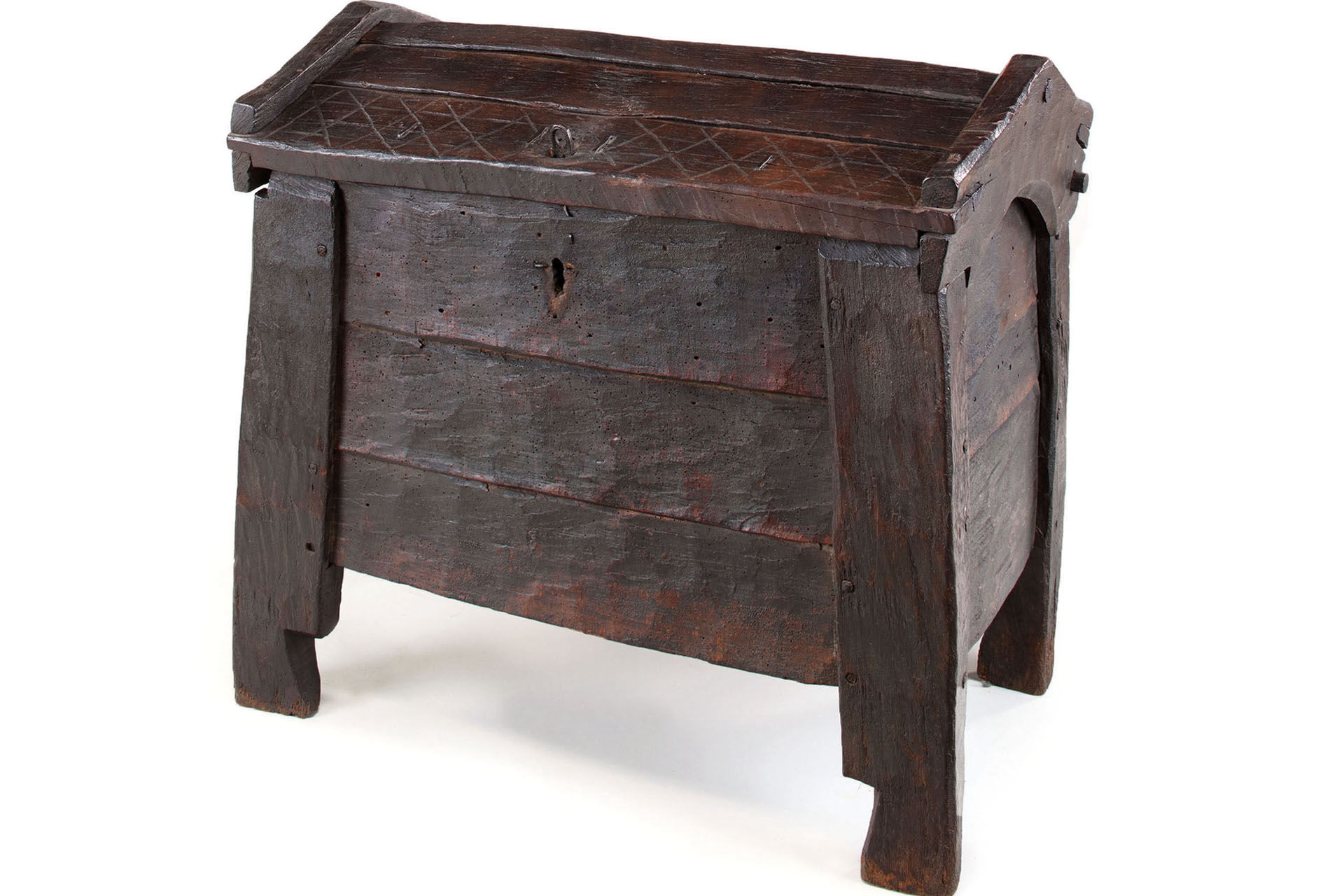
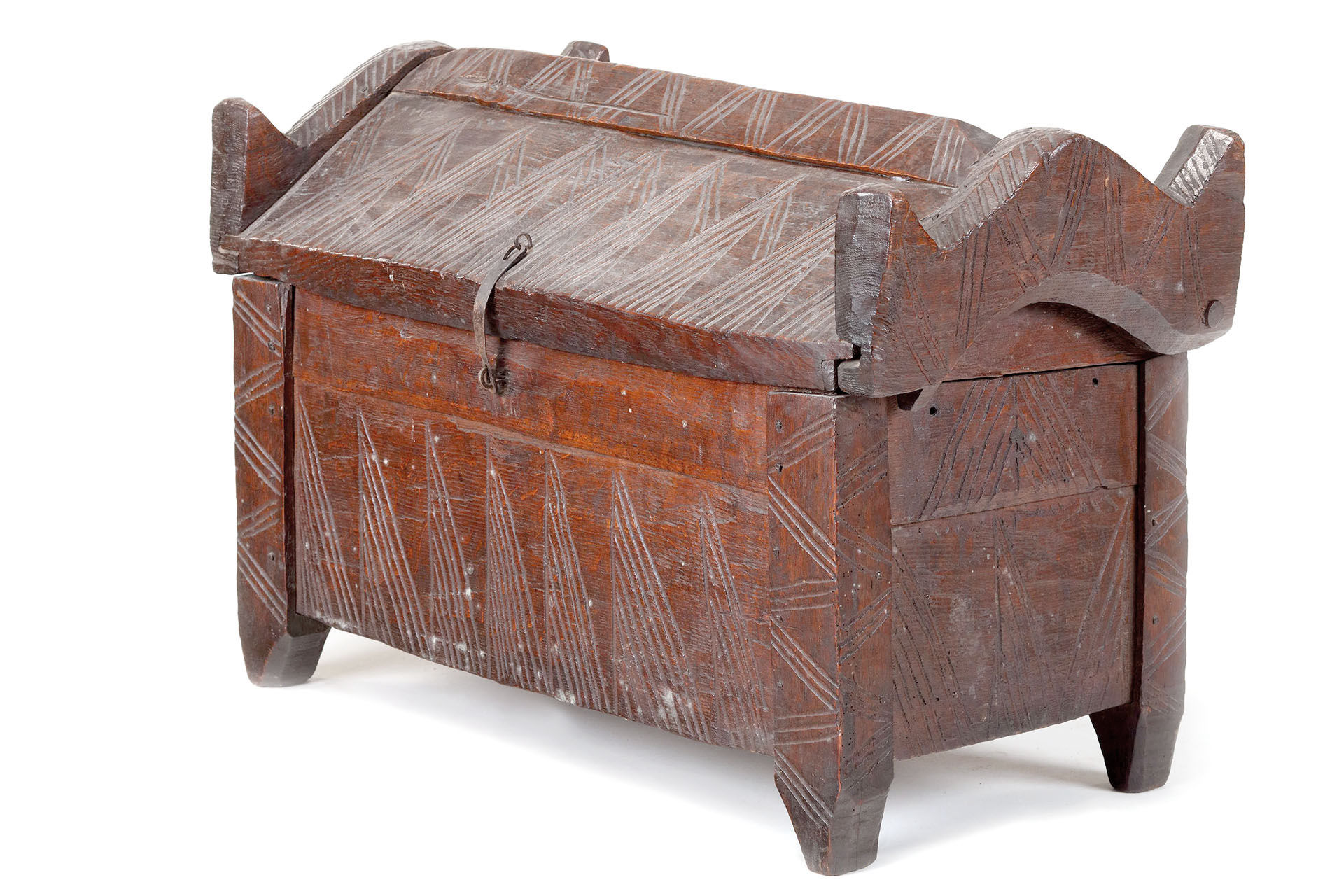
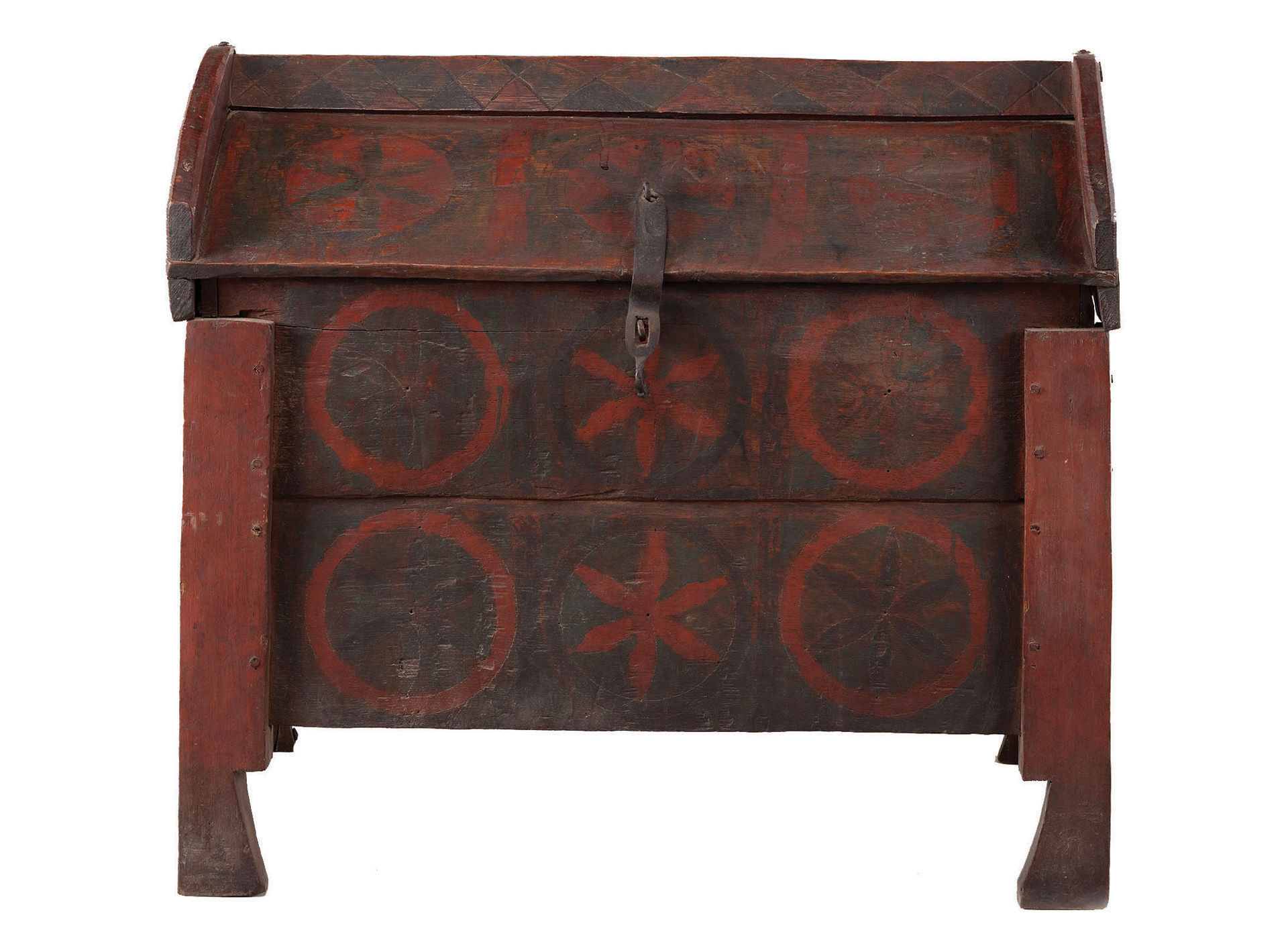
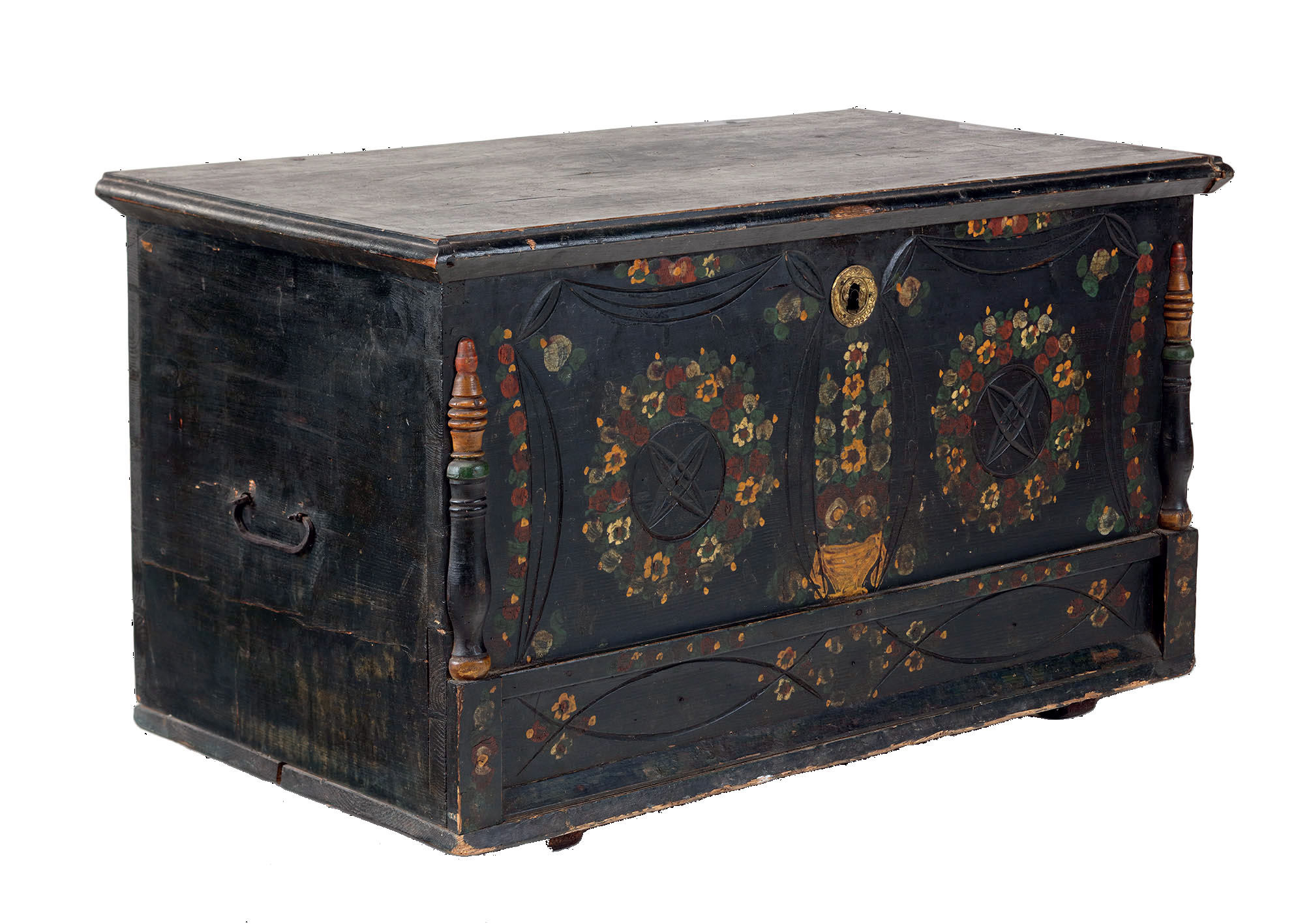
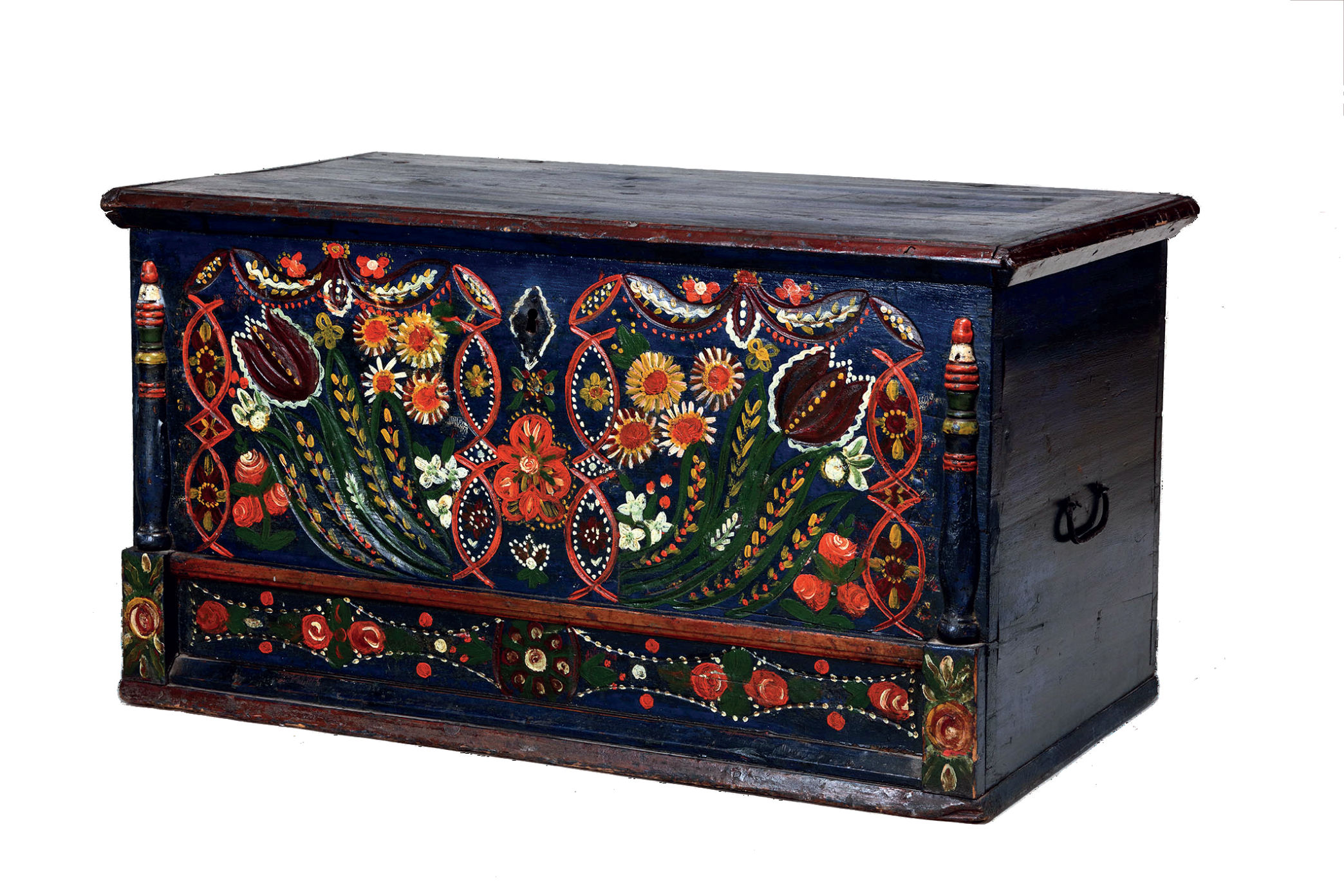
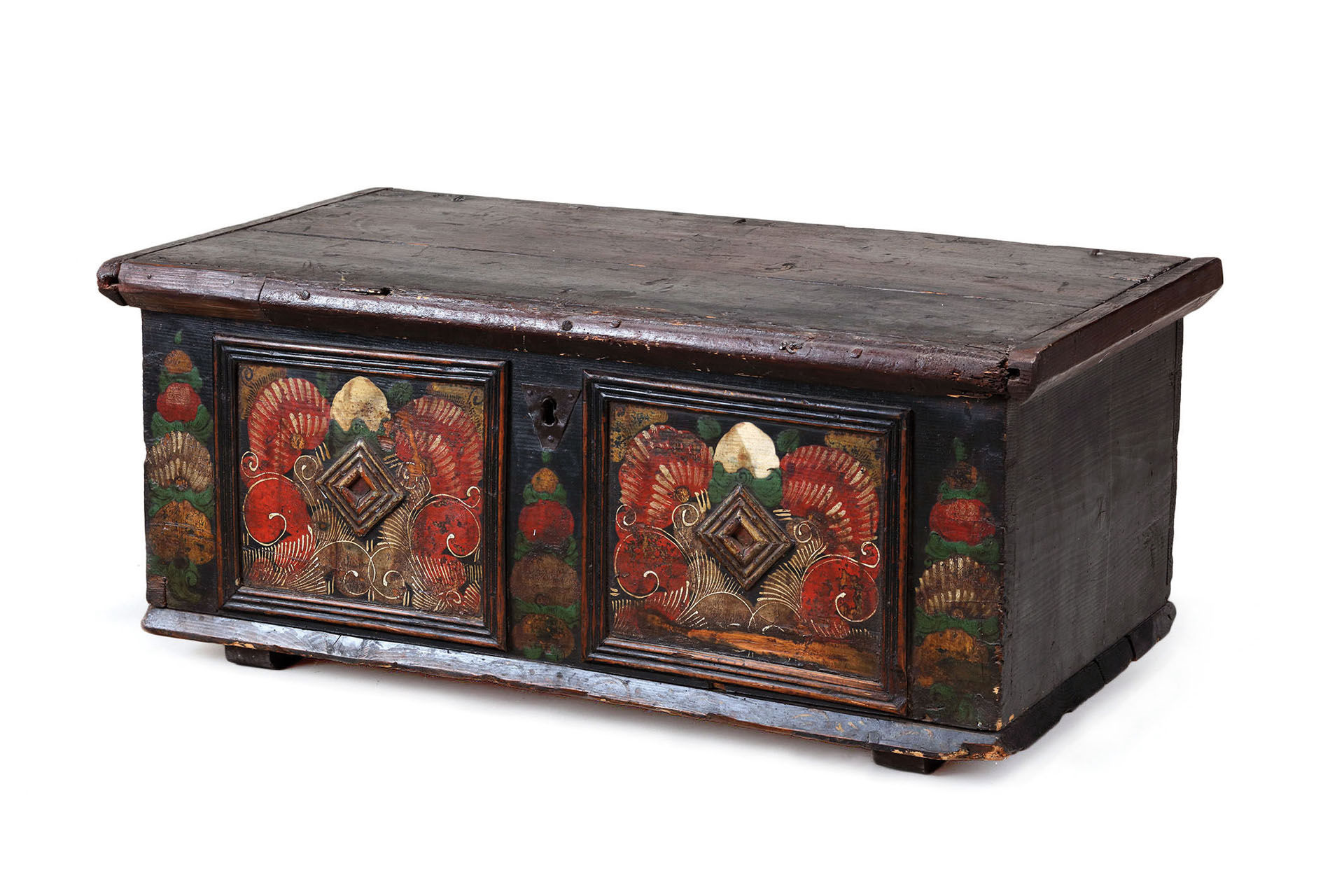
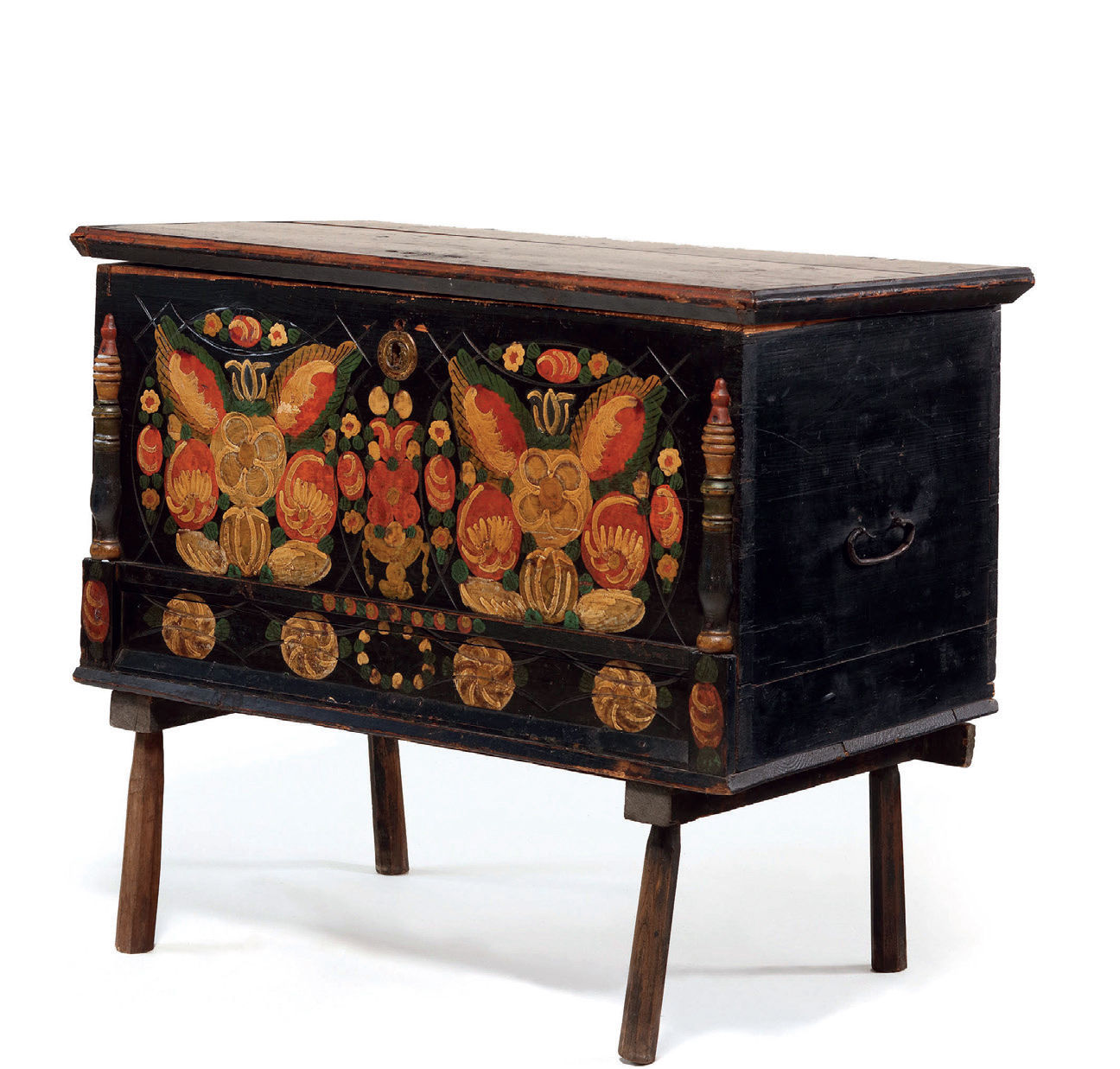
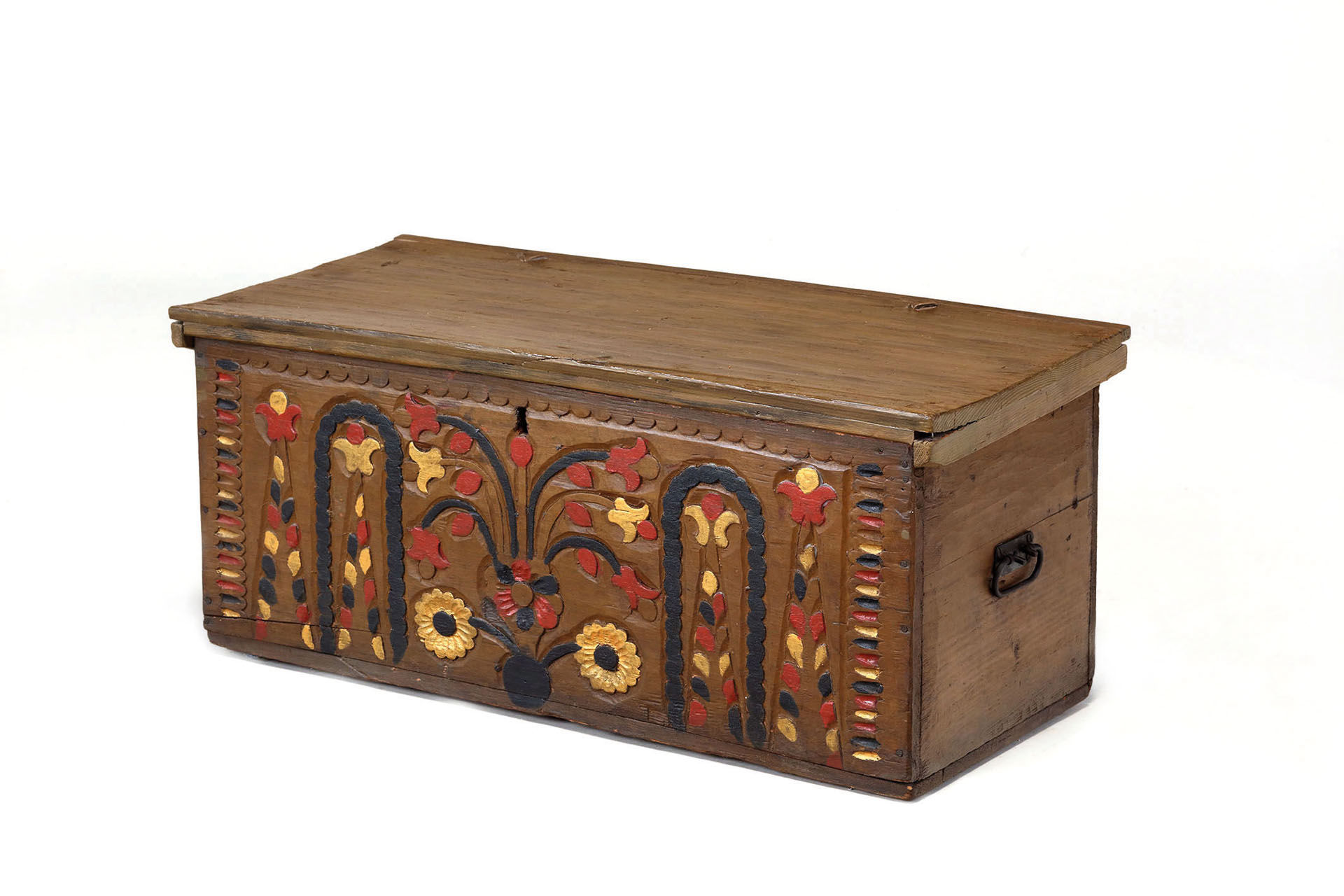
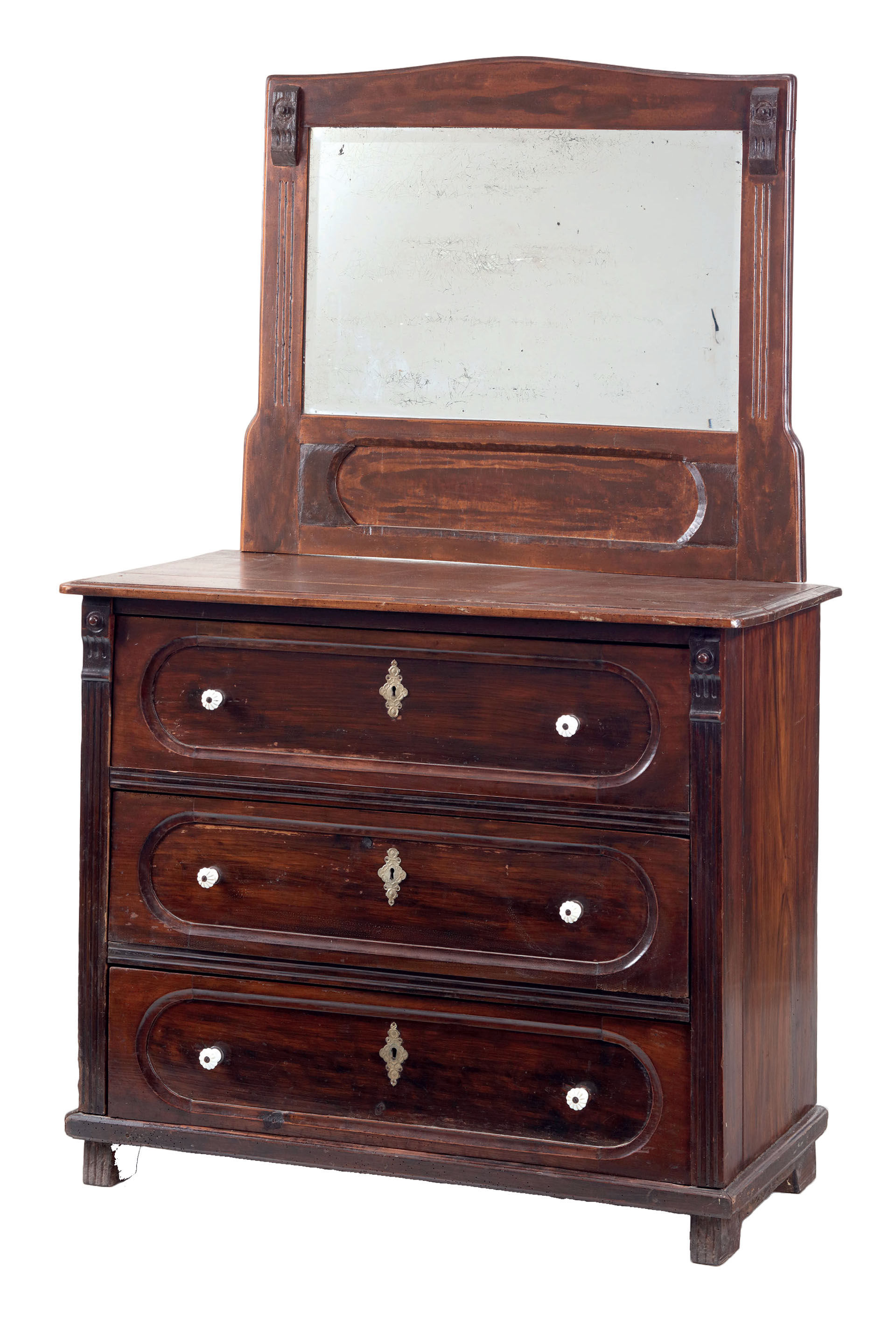
The oldest chest in the Furniture Collection probably dates back to the 18th century because it points to an older manufacturing tradition. It is a cabinet (chest) listed in the Museum’s catalogue as ‘cabinet, antique, made from carved out lime tree wood split in half.’ It has inserted doors made from oak boards. Inside, there are three shelves that served as compartments. The shelves lie on laths tucked into holes drilled into the wall of the cabinet. Given that it became part of Museum’s holdings in the early 19th century, i.e., it was procured in 1931 from Ignacio Keretić, a parish priest in Žažina in Posavina, it had a very long history before arriving at the museum.
It is believed to have been used in the time of the Habsburg Monarchy Militärgrenze and that it served for storing military equipment. Over time, its purpose changed completely, given that its interior was covered in soot and it was likely used for storing cured meat. But, at some point, would it have been used flipped over on its back like a crate? Given its three compartments, was it used for storing grain? These suppositions are confirmed by the fact that this sort of manufacturing tradition dates back to the Middle Ages, as in the case with the chest kept at the Tolmin Museum in Slovenia, which originating in 1700 and was used for storing grain.
Chest, 18th ct., Žažina, Posavina, EMZ 8877
The uniqueness of this piece led to more extensive research of literature revealing new interesting facts.
Thus, in the book Siegwalt Schick. Das Gräberfeld der Merowingzeit bei Ober Flacht, we find a reproduction of a medieval folk chest made from split wooden logs, originating from Oberflacht in Württemberg, where 27 wooden trunks were found at a German cemetery.
It is also believed to be the origin of the German word Totenbaum, i.e. coffin.
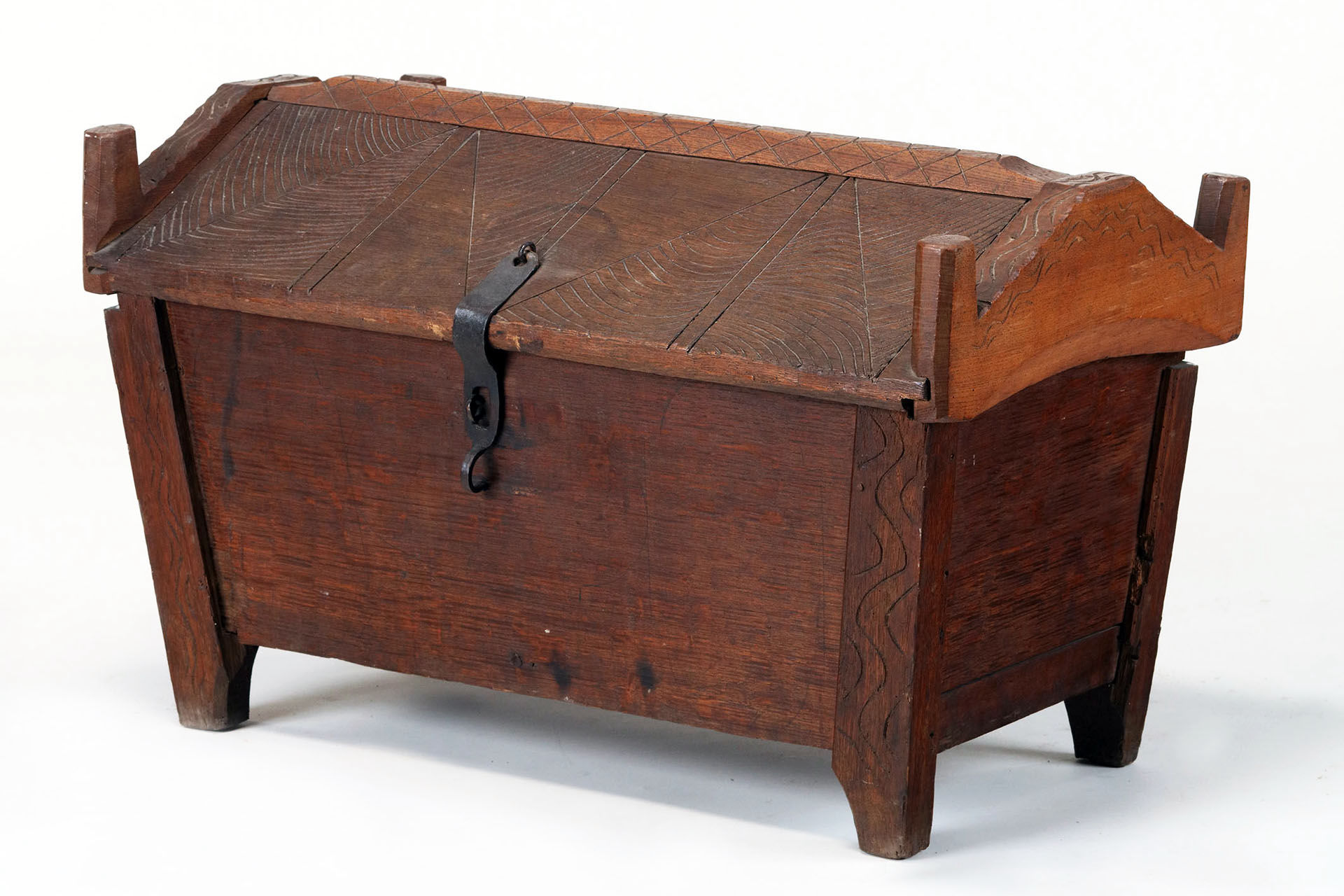
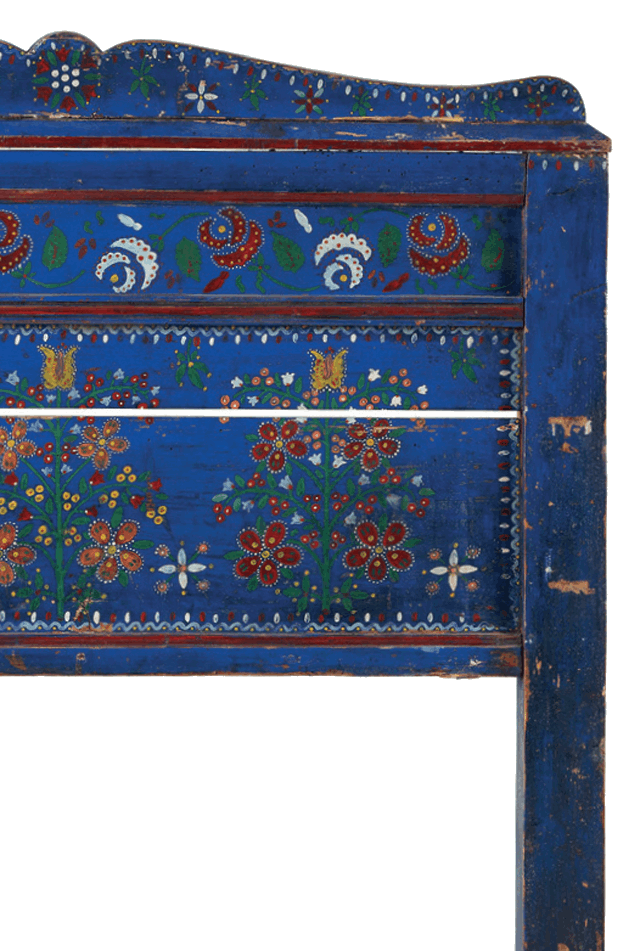
EMZ 46260
Name: Wardrobe
Place: Ivanska, Moslavina
Dimensions: 112 x 45 x 190 cm
Time: 1936.
Some owners if they could write would write in the insides of the doors of their wardrobes the names and birthdays of their children, and the wardrobe, like the whole of the bedroom furniture became a part of their private and intimate life.
Wardrobe, 1936., Ivanska,Moslavina, EMZ 46260
EMZ 62284
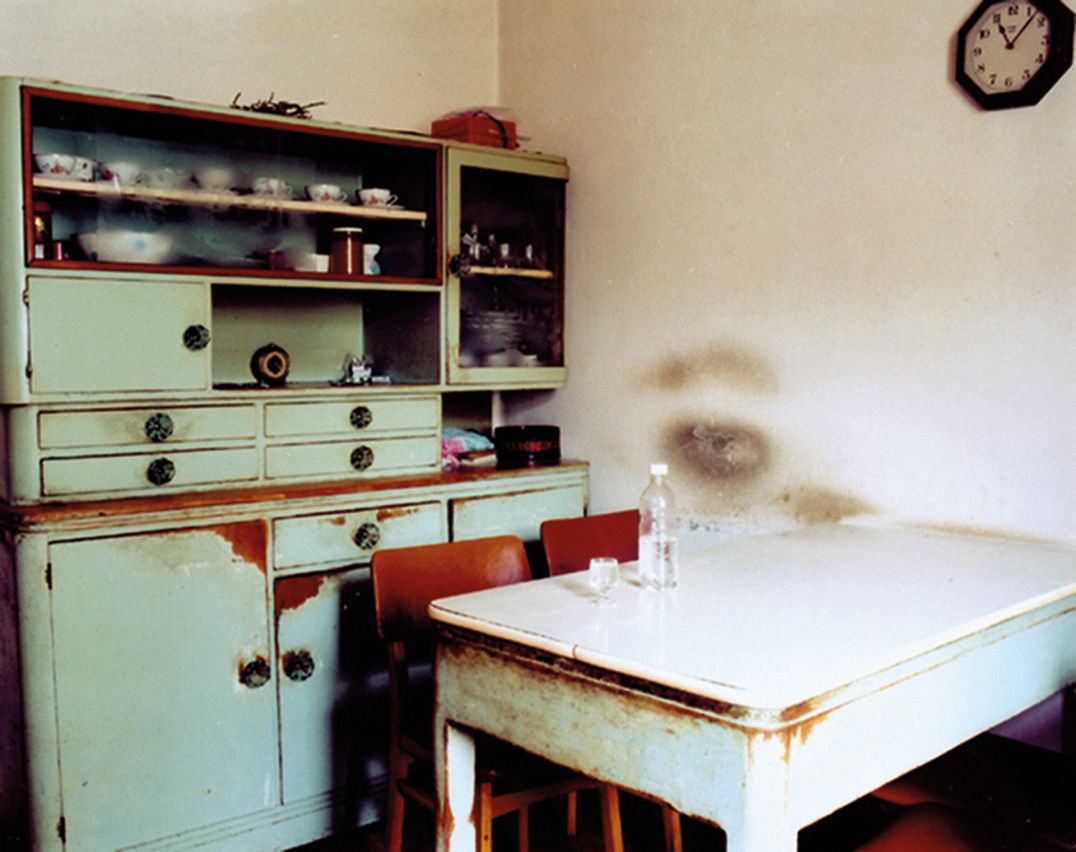
Name: Kitchen dresser
Place: Zagreb
Dimensions: 115 x 169 x 43 cm
Time: 1963.
In the rooms in which cooking went on, shelves were used to put plates
and bowls on, little cupboards in which precious items like salt and
sugar were kept, and a kitchen dresser in which pots and pans were put
away, which were on the whole untidily stacked around the fireplace.
In rural household the dresser came into use in the 1920s and 1930s in
richer households. The upper and lower parts were made of veneered
wood. The upper part often had a glass door, and was called in Slavonian
houses the staklenjak (from staklo, glass), and the lower part the ladičar.
There are also simpler forms of rough workmanship with a closed upper
part without glass. Such a dresser was used as kitchen furniture, meant
for putting away both food and pots, and was in use from the middle of
the 20th century until the present.
Cabinet, Lubenice, 2002., taken by: Petar Strmečki
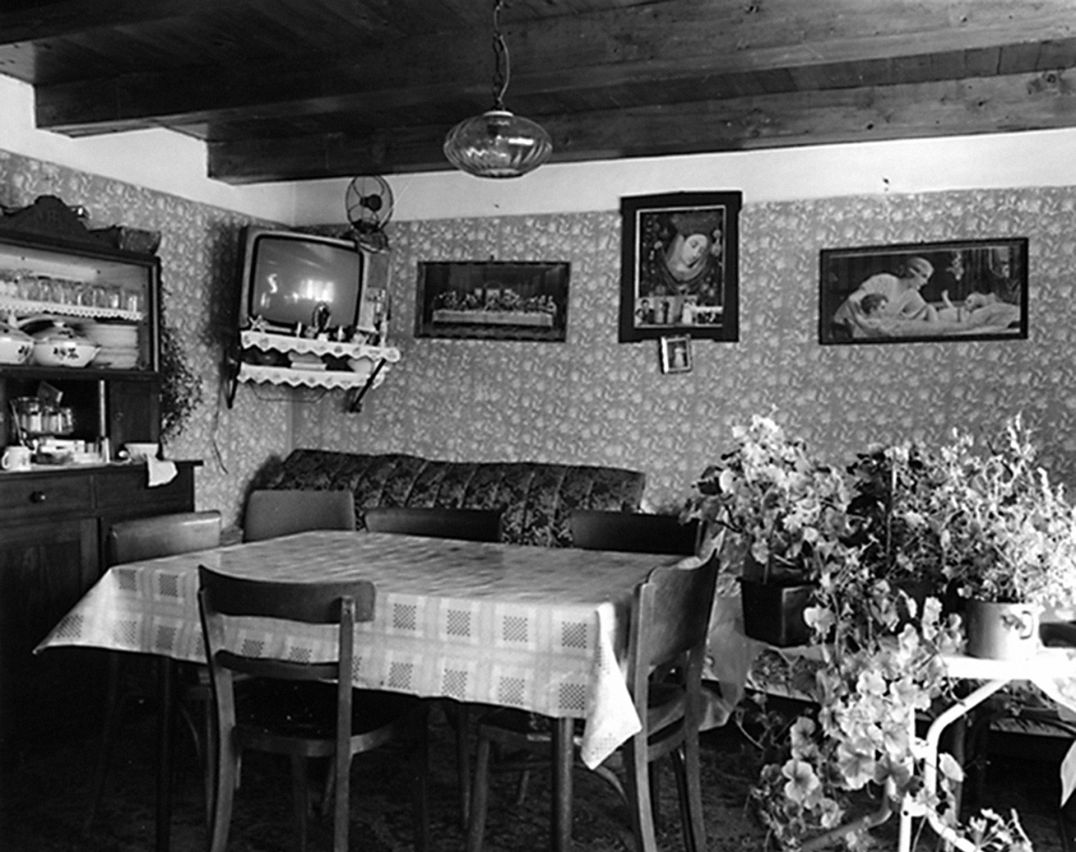
Living room, Novoselec, 2002., taken by: Petar Strmečki
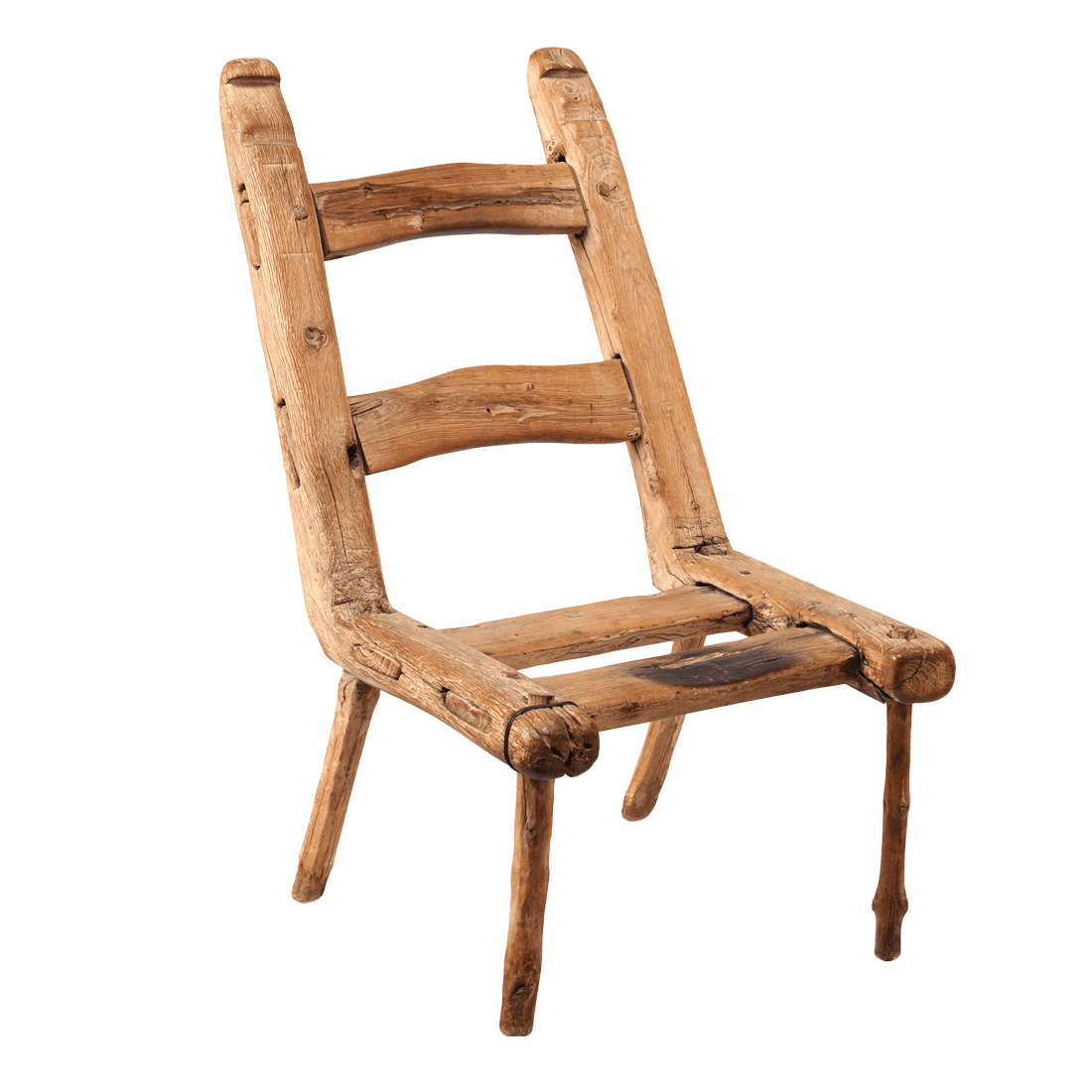
EMZ 29717
Name: Chair, katriga
Place: Listeši, Dalmatinska zagora
Dimensions: 65 x 35 cm
Time: beginning of 20th ct.
A chair had a precisely set place in the arrangement of the furniture. On it sat the gazda, goodman, or the senior member of the extended family and it almost seemed to symbolise his power inside the home.
Katriga, Ksenija Jurinec, 1998.
Katriga, 20th ct., EMZ 29717
A Group of Designers exhibited furniture made from cardboard as ecological material of the future; and individual designers found inspiration in the museum furniture collection and shaped objects in contemporary form. Product designer Ksenija Jurinec used exhibitions to present her products for which she had sought inspiration in the Furniture Collection (Antoš 2018:21). In addition, some artists took their inspiration from objects from the Furniture Collection, like Dora Kovačević. The objects on show were contextualised with a multimedia depiction and the ethnographic film Story of the Chair. In 1999 the Ethnographic Museum was awarded the Charter of the city of Zagreb for a more contemporary approach to the presentation of ethnographic material in the exhibition Furniture in Croatia.
Katriga, Dora Kovačević, 1998
According to lists of dowries on Hvar island from the 16th to the middle of the 19th century, various kinds of beds are mentioned, as is the fact that chests and benches were also used as beds. In sources of the 17th century it was said that on Hvar the people also had iron beds. Mattresses of horsehair are also mentioned as well as beds, with headboards, large and small, and then pallets. The most rudimentary beds in the houses of the poor of the Adriatic area were kavaletas, wooden X-trestles across which planks were laid. From sources from Vis Island we learn that in the Adriatic zone a groom had to buy a bed mostly known by the name of “a person and a half ”, i.e. a bed a bit smaller than two twin beds, known as marriage beds (Bezić - Božanić 1998: 287). “He was bound to provide his wife premises for her to live in and a bed that was completely equipped with the necessary sheets and blankets” (Bezić - Božanić 1992: 87). The poor folk in the Dalmatian hinterland slept on straw beds or woollen blankets. From the accounts of Ivanišević we learn that such a bed was known as odar, and that it had only straw, without the ticking, which was covered with a sheet. “The simplest beds were made of several boards resting on low trestles on top of which came a pallet, and they called it a bed or a sadno, where the older members of the household slept in winter, or on which women gave birth” (Ivanišević 1902: 262).
Bed in house / Mirko Novosel Jarnija, Dugo Selo, taken by:Stjepan Dokuša 10.6.1935., EMZ N 3365
Bed, postelja, 20th ct., EMZ 2860
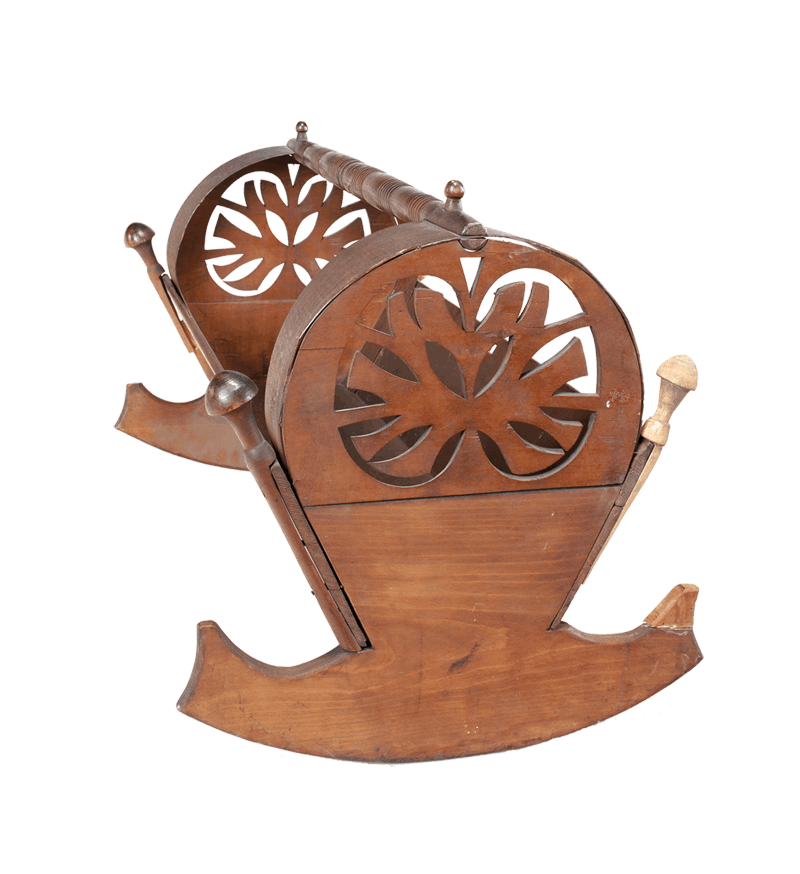
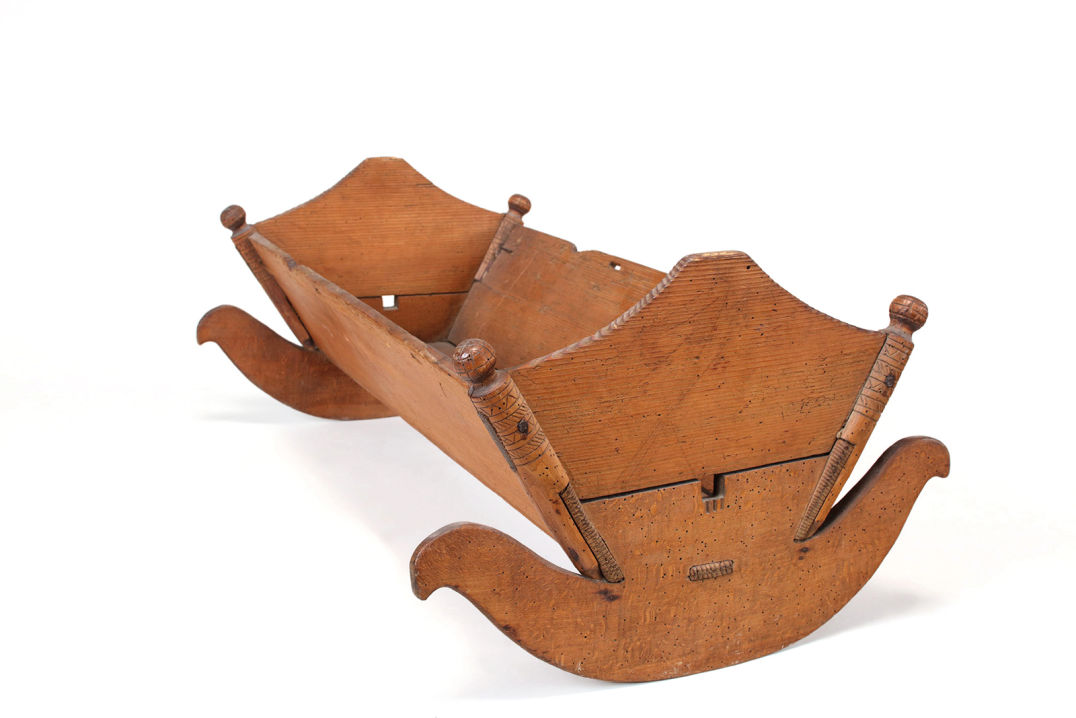
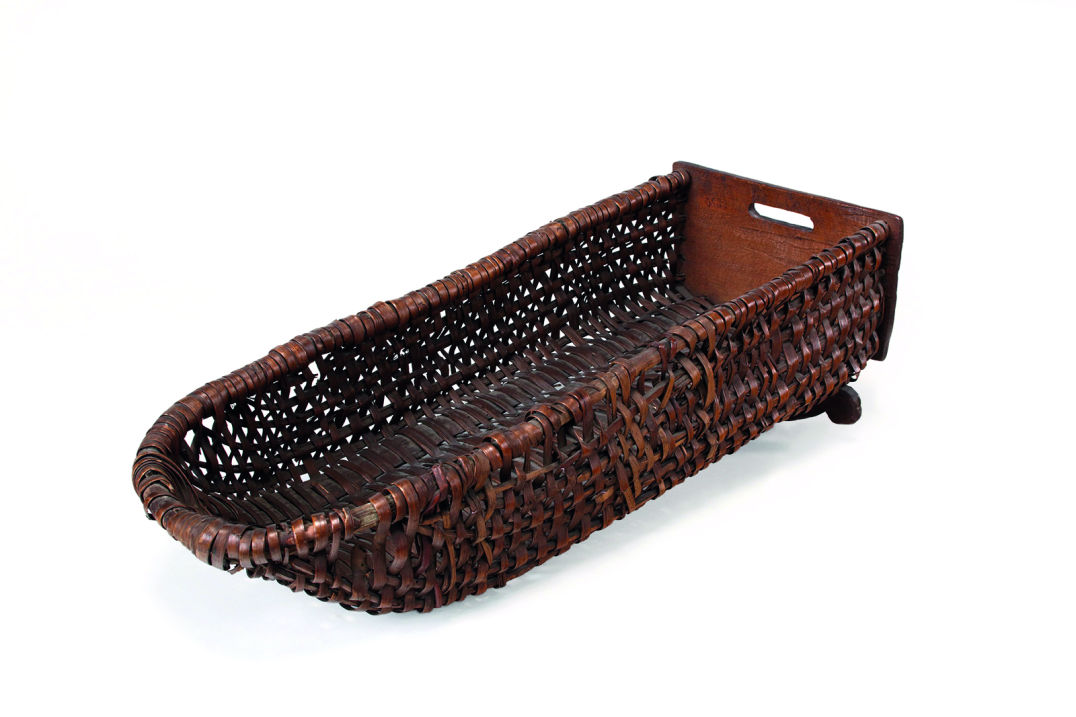
For the youngest in the house to sleep in cradles were used, the names of them varying: zipka, zibela, kolievka, belkica, rajdača, bešika. In the museum collection there are various forms, differing according to the workmanship and the way they were carried. Cradles were most often made of boards in the shape of little boxes, although in the collection there is an example made of wicker. The bottom oval part was used to rock the child while the lower part that was bent into bow shape was used for carrying it. All cradles had perforations at the bottom to keep things dry. Also, on the sides, cradles had holes bored in them through which the baby could be fastened and prevented from falling out while being carried. The child would be lain in the cradle on a bit of hay, ponjava or vanjkuš, or on a pallet and pillow. The child would be placed alongside its mother’s bed, and by day was always close to her. In the daytime when the child was asleep the cradle would be pushed under the bed.
Particular attention was paid to the decoration of the lateral and cross sides of the cradle, which were carved, painted, poker-worked, painted and incised. The most common motifs were plant or geometrical, and the ornamentation was usually considered to have an apotropaic function, warding off evil. A little child was believed to be particularly exposed to the influence of evil forces (mares, fairies, witches) and a mass of means for defence against them were used. By the side of the cradle would be placed a knife, garlic, a mirror, a rosary, a flask of holy water. In some regions, children would be taken to be baptised in their cradles. If there was no cradle, a child might sleep in a trough. The child’s first toys would hang from the stick used to carry the cradle, a sheep bell, a colourful woollen pompom that the child could reach for and play with.
Cradle, zipka, 19th ct., Bukov Vrh, Gorski kotar, EMZ 12973
Cradle, zibeli, 1895., Vrbnik, Island of Krk, EMZ 5832
The consumer society slowly took shape in Croatia during the 1950s; by the mid-1960s, a mass consumer society was developing at great speed, with all its laws, needs, habits, ways of thinking and behaving (Duda 2004: 60). As electricity, plumbing, bathrooms and flush toilets came in, new needs were felt for the possession of up-to-date household objects that were at the same time new markers of social differentiation. These items satisfied various desiderata over and above those implicit in their use value. But the adoption and utilisation of these novelties, precisely because of their use value, hugely influenced the lifestyle of rural and urban populations (the time required for the performance of household tasks decreased, the contents and manner of spending leisure time changed, greater opportunities for information and communication appeared) (Hodžić 1976: 50). The ownership of advanced technologies has always been used as an index of people’s individual wealth and the rise in their standards of living, as well as a status symbol in keeping up with the Joneses. The daily papers devoted a lot of special articles and columns to contemporary working women, particularly the monthly Svijet, where women could learn about lifestyle and spending. Irrespective of whether they earned a wage, women became promoters of consumer culture.
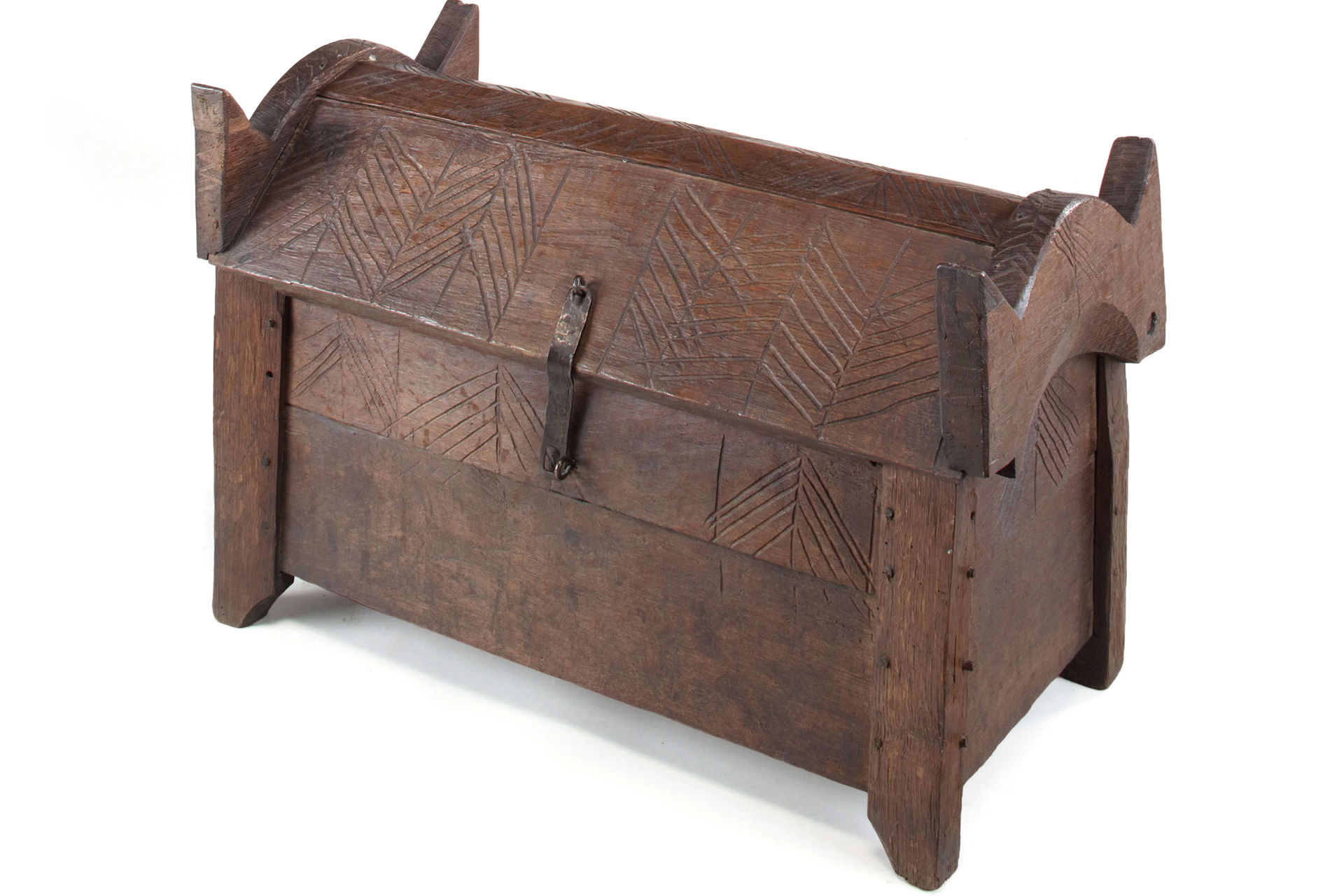
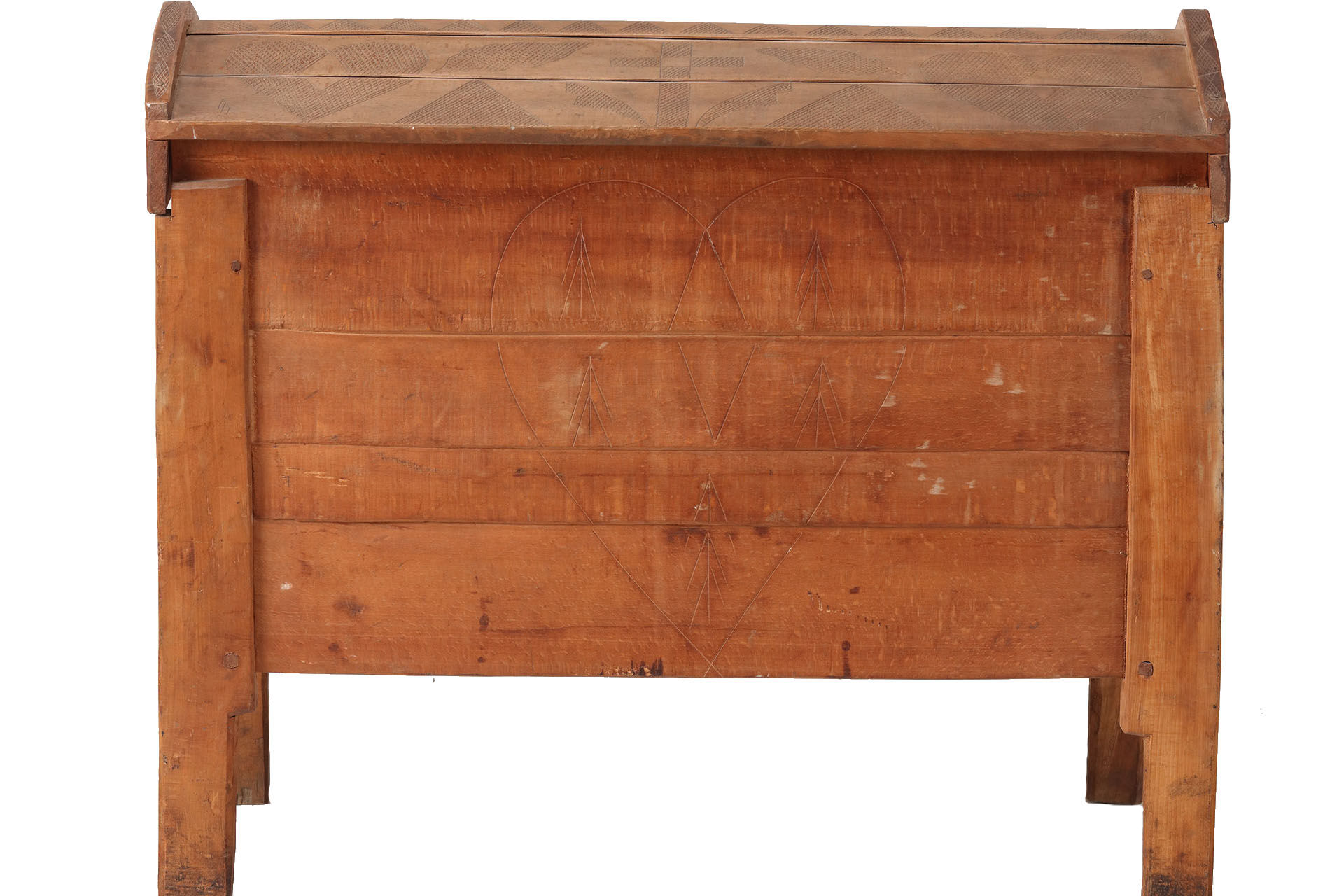
There were various advertising leaflets and flyers prompting
them to choose innovative household items, which could be bought on
the never-never. Igor Duda says that there was a particularly great rise in
hire-purchase agreements in 1956, when there was an increase of about
50%. This rise was particularly marked in the case of loans with a
two- and three-year repayment period, which consumers mostly used
for the purchase of various household appliances. From 1962 to 1965,
the demand for state-of-the-art appliances rose five times, while the real
purchasing power of wages increased by just a third, and the number of
hire-purchase loans by a fifth (Duda 2004: 65).
“Spending in the sixties was on the rise thanks to the earnings of increasing numbers of workers employed short-term abroad, who brought in new habits and previously undreamed of products and used their hard-currency earnings to boost the family standard of living” (Duda 2004: 68). “The support of the working class was won by the raising of the the quality of life. The purchasing power of the population started rising in 1970, reached its peak in 1979 and at the end of the eighties dropped back to the values from the early seventies” (Duda 2010: 156)
Advertising leaflets and flyers, 1960. Source: http://www.gorenje.com/highlights/en/press-information/gorenje-throughtime
Advertising leaflets and flyers 1960. / Source: Private archive: Mario Zrna