WHERE AND HOW WERE THE ITEMS FROM THE FURNITURE COLLECTION DISPLAYED?

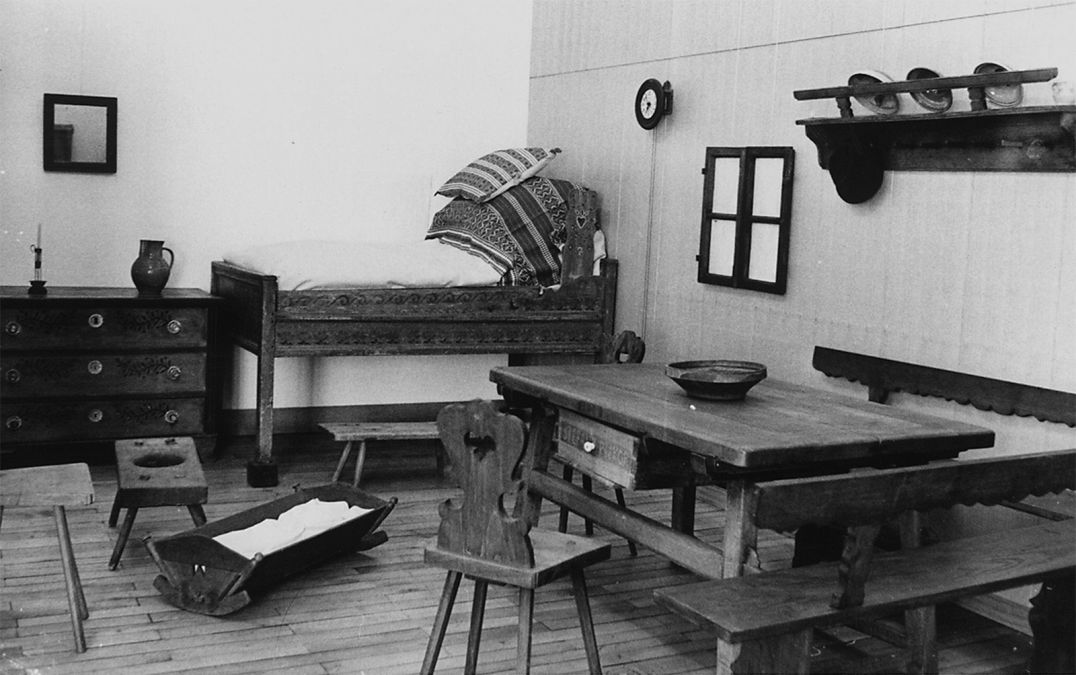
The significance of objects depends not only on their perception during the course of time, but also on the manner in which we look at and display them. Objects are not only shown as objects, but also represent a curator’s selection, a collector’s, and this depends in turn on their audience. It is never one-way, but can be comprehended in two ways, in other words, it depends on the connection of object and public as observer. Displayed objects will thus take on a completely new value. Objects from the furniture collection were exhibited as aestheticsed specimens of folk art in the framework of the permanent displays of the Ethnographic Museum. In the first permanent display or collection from 1922 to 1934, a rural room from Rinkovec, Hrvatsko zagorje, was shown, “furnished with the usual inventory: table, chair, bed, stand, spinning wheel, chest and other things” (Gjetvaj 1989: 29). When the display was reorganised in 1935 there were some minor changes on the first floor where two more interiors were constructed – a room from Prigorje and another from Slavonia, and the interior of a Dinara hut. The concepts of the permanent displays were to show the aesthetic accomplishments of individual objects and the way they fitted together. This display was retained up to the coming of World War II, when most of the material was put away for safety. 


Izlaganje zbirke1

Etnographic past of Zagreb: theme of the interior of a rural house, taken by: Neda Oršalić, 1979., EMZ N 4703

In a second permanent display of 1946-1948, the material was methodically displayed according to zones (Pannonian, Dinaric and Adriatic). On the first floor the earlier conceived four interiors were kept (the interior of a house from Deščevec by Zagreb, from the village of Rinkovec near Zagreb, the village of Drnje in Podravina and from the village of Andrijevci in Bosanska Posavina), and once again the interior of the hut on Dinara was shown. In the newly remodelled space of 1972 on the first floor of the museum a peasant room from Hrvatsko zagorje was shown, and individual examples of furniture from various parts of Croatia, such as chest, shelving, chairs, stools and benches, as examples of interior design.

The objects on display in the permanent collection are contextualised with photographs by the people who used them in a given setting and a given cultural zone. And so objects began to be linked with people as creators and owners of these museum objects in the past. As well as in the museum permanent displays, the furniture was shown at temporary exhibitions at home and abroad. Among them worth pausing on is the exhibition Folk art of Yugoslavia 1949-1951, at which there were smaller decorative items from the collection shown, such as cradles, stools and shelves. It was produced with the Ethnographic Museum in Belgrade, and toured to Zurich, Edinburgh, London, Copenhagen, Stockholm, Geneva and in 1967 to Montreal, in 1969 to Ingleheim, in 1988 to Sofia and 1989 to Helsinki. Shown in the Art Pavilion in 1972 was the exhibition Wood in folk creativity in the framework of which 214 objects were displayed, encompassed according to thematic units (natural forms, gouged and hewn, bent, turned and visually designed wood). Then in the Ethnographic Museum another exhibition was put on, Wood in Traditional Working, 1974, which went on tour to Ljubljana in 1975, after which in 1980 the exhibitions Selected items of rural furniture, in the context of which examples of benches, chairs and tables were shown, and in the exhibition Forms of rural chests in the SR of Croatia in the Marko Šavrić Factory in Zagreb. At the exhibition From the national heritage of the Adriatic, which was put on in the Ethnographic Museum in 1981, objects from the Furniture Collection that came from the Adriatic region were shown; at the exhibition Baranya – tracking the ethnographic heritage, which was put on in 1985, examples of furniture from Baranya were displayed. Objects from the Furniture Collection were shown in the context of various individual exhibitions that had furniture in the context of some broader topic, like the exhibition Croatian Traditional Folk Culture, which was put on in Budapest in 2000, the Art Pavilion in Zagreb in 2001, and in Buenos Aires and Santiago de Chile in 2002. In addition, objects were also put on display in the context of the reconstructions of some interiors in the exhibition Podravina, Baranya show their colours, 2006, put on in the Ethnographic Museum in Zagreb. At the study exhibition Furniture in Croatia, an ethnological view of the interior decoration of the home in the Ethnographic Museum in Zagreb in 1998, touring to Ljubljana in 1999 and Kitsee in 2001, furniture was comprehended from a wider aspect and looked at in the framework of an ethnological view of the culture of living. Visitors were not longer passive observers, but active commentators and participants.
Katriga, Ksenija Jurinec


  Katriga, Ksenija Jurinec, 1998.

Katriga


  Katriga, 20. st., EMZ 29717

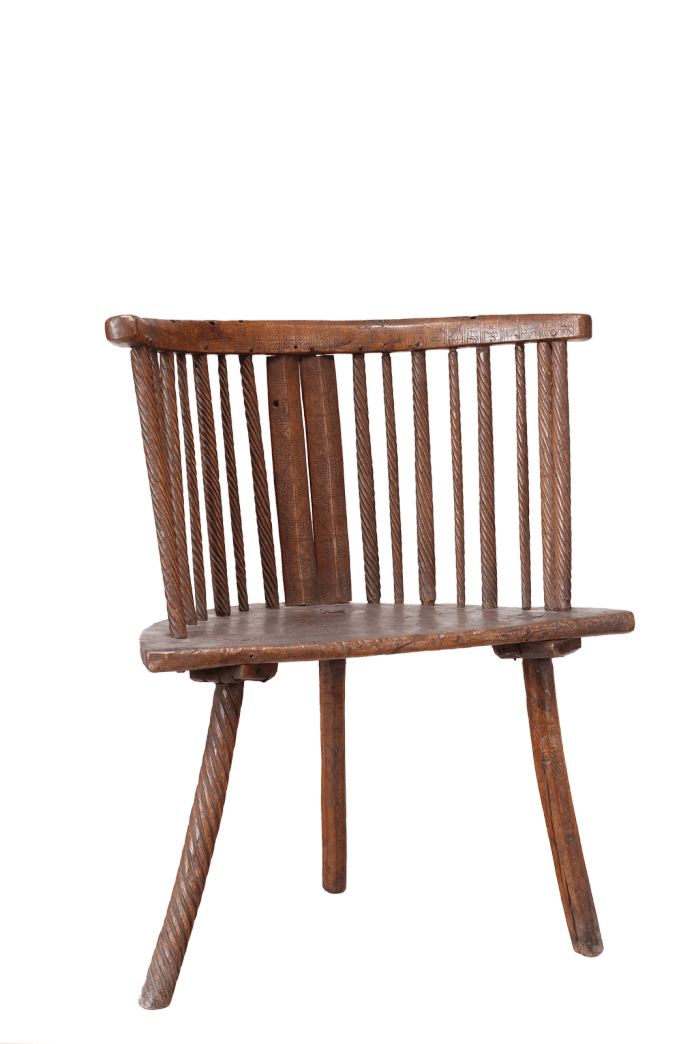
A Group of Designers exhibited furniture made from cardboard as ecological material of the future; and individual designers found inspiration in the museum furniture collection and shaped objects in contemporary form. Product designer Ksenija Jurinec used exhibitions to present her products for which she had sought inspiration in the Furniture Collection (Antoš 2018:21). In addition, some artists took their inspiration from objects from the Furniture Collection, like Dora Kovačević. The objects on show were contextualised with a multimedia depiction and the ethnographic film Story of the Chair. In 1999 the Ethnographic Museum was awarded the Charter of the city of Zagreb for a more contemporary approach to the presentation of ethnographic material in the exhibition Furniture in Croatia. Then the furniture of the collection was shown at the exhibition Lets have a coffee, a view of Zagreb entrepreneurs on the culture of coffee consumption, which was put on in the Ethnographic Museum in 2010 and in Zadar in 2014. Some interiors were reconstructed for this show (Bosnia, Central Croatia), which illustrated the coffee culture as part of everyday life. At the virtual exhibition Chest full of digital secrets that was mounted on the Internet site of the Ethnographic Museum in 2021 chests were shown from the furniture collection that had never been fully displayed previously. In this virtual exhibition we wanted to show the manner in which certain objects tell something, and how people have used them, certain forms of everyday life being examined, including their purpose and use, making and decoration, as well as the symbolism of the objects. It is planned for furniture from the collection to be shown in the new permanent display of the Ethnographic Museum in Zagreb as a part of the depiction of the culture of living as a whole. A preliminary and an implementation design for the new permanent display were worked out in 2018 in the context of the project Renewed heritage for Sustainable and Smart Development in a Hyperlinked World (2016- 2018) which was produced according to a contract with the Ministry of Regional Development from the European Structural and Cohesive Funds in partnership with the Croatian Chamber of the Economy and the Ethnographic Museum.

Katriga Dora Kovačević

  Katriga / Chair, Dora Kovačević, 1998

Katriga2 Dora Kovačević

  Katriga / Chair, Dora Kovačević, 1998

Stolac

  Katriga / Chair, 19th ct. EMZ 15936

The Ethnographic Museum also went into partnership with the students of the Forestry Faculty, wood and furniture design major, of the Architectural Faculty in Zagreb, product design major, who presented an exhibition of works the inspiration of which came from the museum collection, new products being designed in 2018 and 2019. The objective of the project was to promote the cultural heritage as source of inspiration for and the creation of new contemporary products that enable accessibility to the heritage for all kinds of visitors. Participation of the Ethnographic Museum in the project enabled more focused research into the theme of the culture and creative industries, as well as the possibility of applying the most recent museological methods that were aimed at involving the public actively through co-creation in the reinterpretation of objects from the collection. From these varied sources and manners of interpretation of museum objects, new meanings of museum objects are created and changes that relate not only to a single item or several items of the same kind, but can also completely lose their roles and initial purposes, taking on completely new functions in society.

Ethnographic Museum
Trg Mažuranića 14 
Zagreb, 10000 HR 
+385 (01)4826 220 
emz@emz.hr

  • Text and catalogue entries by: Zvjezdana Antoš, PhD, museum adviser
  • Photographs: Goran Vranić, Nina Koydl, Petar Strmečki, Ethnographic Museum's Photo Archive
  • Web design and development: Viola Šebalj
  • Subediting and proofing: Andrea Rožić
  • English translation: Graham McMaster, PhD
  • For the publisher: Goranka Horjan, PhD, museum adviser

  • © Copyright Etnographic Museum, Zagreb, 2022.
  • The exhibition was financed by the Ministry of Culture and Media, Republic of Croatia, City of Zagreb - City Office for Culture, International Relations and Civil Society