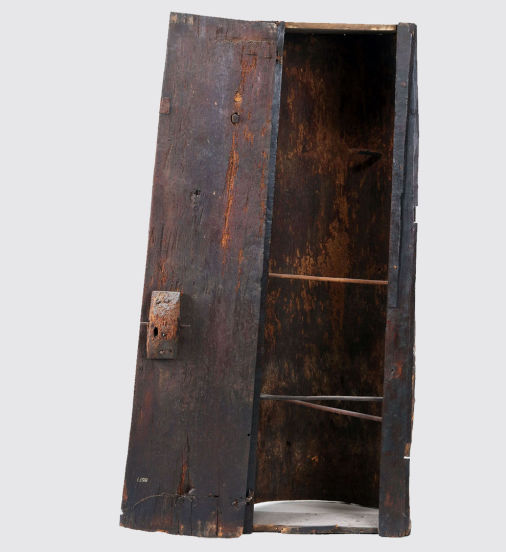
Ethnographic Museum, The Furniture Collection, EMZ 8877
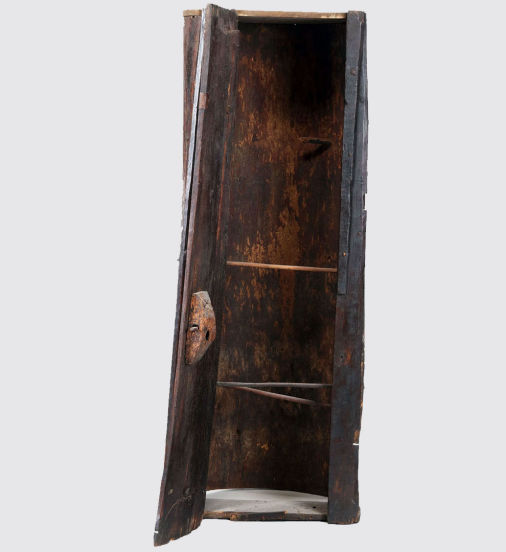
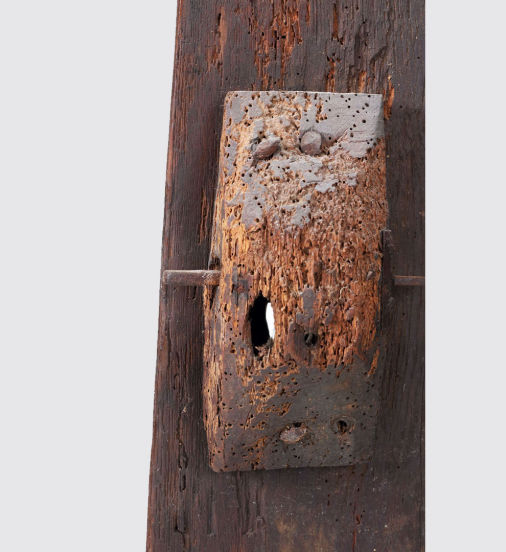
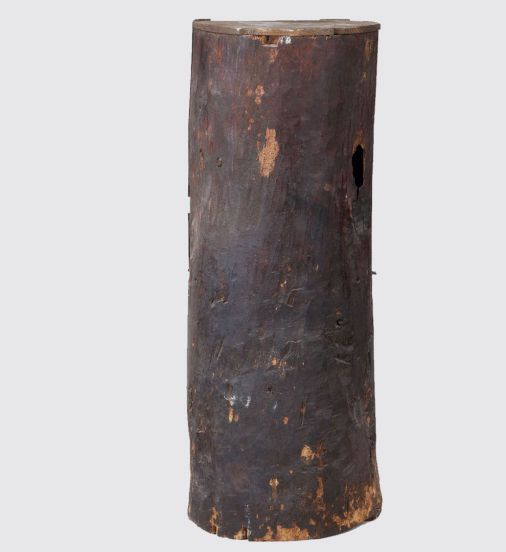
The oldest chest in the Furniture Collection probably dates back to the 18th century because it points to an older manufacturing tradition. It is a cabinet (chest) listed in the Museum’s catalogue as ‘cabinet, antique, made from carved out lime tree wood split in half.’ It has inserted doors made from oak boards. Inside, there are three shelves that served as compartments. The shelves lie on laths tucked into holes drilled into the wall of the cabinet. Given that it became part of Museum’s holdings in the early 19th century, i.e., it was procured in 1931 from Ignacio Keretić, a parish priest in Žažina in Posavina, it had a very long history before arriving at the museum.
It is believed to have been used in the time of the Habsburg Monarchy Militärgrenze and that it served for storing military equipment. Over time, its purpose changed completely, given that its interior was covered in soot and it was likely used for storing cured meat. But, at some point, would it have been used flipped over on its back like a crate? Given its three compartments, was it used for storing grain? These suppositions are confirmed by the fact that this sort of manufacturing tradition dates back to the Middle Ages, as in the case with the chest kept at the Tolmin Museum in Slovenia, which originating in 1700 and was used for storing grain.
The uniqueness of this piece led to more extensive research of literature revealing new interesting facts.
Thus, in the book Siegwalt Schick. Das Gräberfeld der Merowingzeit bei Ober Flacht, we find a reproduction of a medieval folk chest made from split wooden logs, originating from Oberflacht in Württemberg, where 27 wooden trunks were found at a German cemetery.
It is also believed to be the origin of the German word Totenbaum, i.e. coffin.
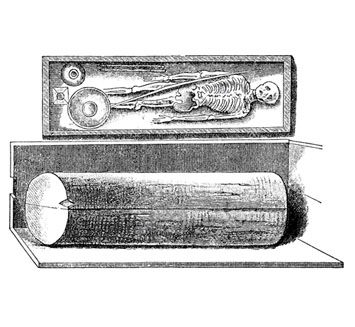
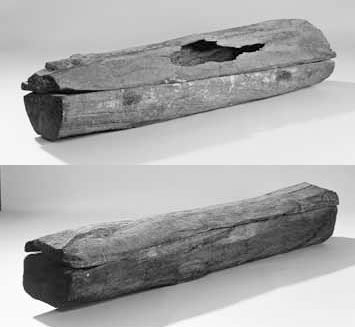
The chests for grain storage were likewise constructed in different ways and it is believed that such trunks found in Slovenia, made out of split logs, belong to an older furniture making tradition that was based on improvisation, while they are known to have been manufactured during the Middle Ages in Germany, Switzerland, France and England.

Ethographic Museum
Trg Mažuranića 14
Zagreb, 10000 HR
+385 (01)4826 220
emz@emz.hr